Spent two long, energizing days here in Philly so far preparing and organizing canvasses of voters, calling new voters, making maps for E-Day and such. Three more to go. Everywhere energy is high. Philadelphia’s new registrations are overwhelmingly Democratic – no surprise, given the edge we have in Philadelphia, and among new voters – but, well, very overwhelmingly so. So are the sentiments of the folks we;ve run into all around the city. Of course, turnout is the name of the game. At least if you’re a Democrat. If you’re a Republican, it seems to be whatever the opposite of turnout is – turn in, perhaps? The reports are already coming in of nasty tactics to stop more of our folks from voting because, it seems, they can’t find any more of theirs to. So if you see, say, a sign in a low-income neighborhood saying your polling place has been changed, be skeptical. Or better yet, check it out and then call a lawyer.
Tag Archives: organizing
Saturday I was back in Pennsylvania talking to voters, this time in a more conservative suburban part of Plymouth Meeting. My most interesting encounter was with a 76 year-old Democrat who declined at first to mention any particular issue she concerned about but volunteered that she and her husband would vote for Kerry. Then as I was leaving, she asked if she could get my opinion on something “as a young person.” I watched her visibly struggle to describe the incident that had struck her – Kerry’s mention of Mary Cheney in the debate – and finally explain it as his reference to her being “I forget the word…um, a girl who has a girlfriend, if you know what I mean.” She was clearly troubled by the concept, and I braced myself for a difficult debate about it.
Figuring it was best to answer the question she’d explicitly asked – what I thought when Kerry mentioned her, I responded with something like, “Well, I don’t think it’s particularly necessary or gracious to bring up an opponent’s family member if they haven’t already. And I don’t think it was necessary to make his point, which itself was a good one. But I think the Cheneys complaints about it seem incredibly shallow given that they didn’t seem to have a problem when the Presidential candidate on their ticket tried to write an ammendment directed against their daughter into the constitution.”
She nodded as if carefully considering what I was saying, and it was clear that she agreed with one part and disagreed with another. And then she said something that blindsided me: “It seemed to me like he really cared about her. It seemed like he really was concerned about what she’s going through and he was trying to understand. And that really impressed me.”
Coming from a woman who couldn’t bring herself the use the word lesbian, they were very moving words to hear. I don’t know what they mean for the struggle for the White House. But in the struggle for legal equality in this country, it’s hard to see them as anything but a good sign which speaks to the desire even among many of the Americans who can’t yet reconcile themselves to other lifestyles to see leaders who respect and understand those who practice them. That is, if we’re swaying the 76 year-old white Pennsylvanian women, we’re on the right track.
Spent the day in Pennsylvania’s Lehigh Valley with a horde of other labor folks from Connecticut and Pennsylvania talking to union members about Bush’s record and Kerry’s vision. It was a real energizing, inspiring time. One woman told me that we need to get Bush out so that we can “give money to working people, not oil rascals.” Another told me that, “My husband and I worked hard our whole lives to be able to retire like this, and I just worry about those young folks looking for work today – where are they going to find jobs? And what are they going to have to retire on? We need a President who understands what it’s like to be a working person.” She shared that she took offense as a Catholic at attempts to tar Kerry as a bad Catholic. “He doesn’t agree with abortion, but he doesn’t think it should be up to the government, and personally I think it’s wrong, but I’m not really in a position to tell those young women what to do. And what about all those men and women and children we’re killing in Iraq?”
And then I came home and got to top the day off by reading this:
With a solid majority of voters concluding that John Kerry outperformed George W. Bush in the first presidential debate on Thursday, the president’s lead in the race for the White House has vanished, according to the latest NEWSWEEK poll. In the first national telephone poll using a fresh sample, NEWSWEEK found the race now statistically tied among all registered voters, 47 percent of whom say they would vote for Kerry and 45 percent for George W. Bush in a three-way race…Four weeks ago the Republican ticket, coming out of a successful convention in New York, enjoyed an 11-point lead over Kerry-Edwards with Bush pulling 52 percent of the vote and the challenger just 41 percent. Among the three-quarters (74 percent) of registered voters who say they watched at least some of Thursday’s debate, 61 percent see Kerry as the clear winner, 19 percent pick Bush as the victor and 16 percent call it a draw. After weeks of being portrayed as a verbose “flip-flopper” by Republicans, Kerry did better than a majority (56 percent) had expected. Only about 11 percent would say the same for the president’s performance while more than one-third (38 percent) said the incumbent actually did worse that they had expected. Thirty-nine percent of Republicans felt their man out-debated the challenger but a full third (33 percent) say they felt Kerry won.
Kerry’s perceived victory may be attributed to the fact that, by a wide margin (62 percent to 26 percent), debate watchers felt the senator came across as more confident than the president. More than half (56 percent) also see Kerry has having a better command of the facts than Bush (37 percent). As a result, the challenger’s favorability ratings (52 percent, versus 40 percent unfavorable) are better than Bush’s, who at 49 percent (and 46 percent unfavorable), has dipped below the halfway mark for the first time since July. Kerry, typically characterized as aloof and out of touch by his opponents, came across as more personally likeable than Bush (47 percent to the president’s 41 percent).
Mark Schmitt chooses a peculiar way to frame his question of whether progressivism can go on without labor:
Given the depth of labor’s difficulties, then, perhaps the reason that the answer to the question is “yes” is simply that we can’t wait for labor to solve its problems, and maybe labor never will come back in its traditional form.
The issue isn’t whether the Democratic Party or the left should “wait for for labor to solve its problems.” The issue is why the Democratic Party has failed to more aggressively pursue policies which would address the problem which haunts all prospects for sustained electoral or organizing victory: the absence of a robust freedom to form a union and organize collectively for industrial democracy and social change in this country.
Today I was discussing with a Professor the psychic wages of constructing the civil rights movement as a spontaneous outpouring against injustice rather than the carefully planned series of organizers campaigns in was, in that the former makes it easier to abrogate one’s responsibility to support the work of organizers for justice today. One of the most incredible of those organizers, then and now, is the Reverened James Lawson, who writes on Labor Day:
Service sector work today is increasingly the province of a caste, of men and women deemed unworthy of basic human rights. It matters not how hard they work nor how valiantly they strive: they are condemned, as are their children and their children’s children, to forever toil in the wilderness. The promise that defined life in America for so many generations and that gave this nation a true “middle class” does not extend to them: work hard, play by the rules, and you will get ahead. But Labor Day is not the time for lamentation over what was or even what is. Let us be inspired, instead, by those who have a vision of what can be and, moreover, are pursuing their vision with strategy and passion. Hotel workers are being arrested in the streets of Los Angeles. They are marching in San Francisco and Washington, D.C. and many other cities in North America. What do they want? You may not yet be aware of it, but a powerful idea has gripped the minds of tens of thousands of these “outcast” service workers, and it will not let them rest. They believe their labor should and can lead to a better life, and they intend to make that happen. After all, Jesus of Nazareth said, “The laborer deserves his wages.” In the last century, the “outcast” workers in low-paid, dead end manufacturing jobs organized unions. They turned those jobs into the foundation of America’s middle class. Today, hotel workers are organizing to redefine the nature of their jobs and open up their opportunities.
I’d say Kerry’s speech is comparable to Edwards’: it hiet each of the major points it needed to, with some good moments that were memorable in the short-term but seem un-likely to get re-aired on on C-SPAN at future conventions, and some low points too.
I’d say he did a largely effective job of talking sympathetically in about his own life in a way which personalized him while tying him to a national narrative and avoiding appearing self-aggrandizing or apologetic. His explicit gendering of his parents was irritating. His unapologetic ownership of the accomplishments of 60’s movements was gratifying. His refusal to mention gay liberation, or the gay community, was not.
It was good to hear the word “poverty,” but disappointing not to hear more about it, and particularly not to see Kerry’s support for raising the minimum wage and recognizing card count neutrality agreements touted as centerpieces of his economic plan. I did think he set forth his stance on the Bush tax cuts with admirable frankness and simplicity, and in a way which doesn’t leave the Republicans much room to maneuver.
I remain pleasantly surprised to see Kerry talking about spending more money on Head Start instead of the prison system, a welcome departure from Clinton’s strategy of apeing Republican rhetoric on crime. The fact that the line has the entire staff of The New Republic apoplectic is a good sign. Calling the “family values” crowd on not valuing families is well-deserved and long overdue. Reaching out to those who self-identify as people of faith is all well and good, but you don’t need to announce that you’re doing it. The Lincoln quote is one of the great ones in American politics, and put here to great use.
All that said, it’s an exciting night.

The Times makes a poor attempt to contrast Kennedy’s and Obama’s speeches last night:
If Mr. Obama reached for the middle with his promise of a new kind of politics under Mr. Kerry, Mr. Kennedy spoke to the most fervent and frustrated Democratic voters, weary after four years out of power.
This unfortunate sentence echoes some of the false synechdoches I find most frustrating in the way we discuss politics in this country: Eliding a positive vision with moderation and a negative critique with extremism, partisanship with ideology, open-mindedness with moderation, and the disengaged or disenfranchised with the moderates. Kennedy’s speech touted the historic accomplishments of the Democratic party and condemned the crimes of the Bush Administration. Obama’s drew on his narrative and those of his neighbors to craft a vision of the urgency and potential of democratic politics. There’s no cause to identify the former as a more radical project than the latter, and strong ground on which to argue the reverse.
It shouldn’t be a surprise, given the tremendous success of Obama’s speech and the lack of Black leaders with popularity and credibility articulating the right’s view of the path to Black uplift, that some conservatives would try to claim the speech as their own. Witness Roger Clegg’s flat attempt over at the National Review‘s Corner:
Barack Obama gave a fine speech, but it was not a speech that reflects the current Democratic Party. It celebrated America as “a magical place”; it did not bemoan our racism and imperialism. It professed that this black man “owe[d] a debt to those who came before” him; it did not call for reparations. It spoke of an “awesome God”; it did not banish Him from public discourse. It admitted that black parents, and black culture, need to change the way black children are raised; it did not blame or even mention racism. It quoted “E pluribus unum” and translated it correctly as “Out of many, one”; it did not misquote it, as Al Gore infamously did, as “Many out of one.” Most of all, the speech celebrated one America, “one people,” and rejected the notion of a black America, a white America, a Latino America, and an Asian America–a notion completely foreign to the multiculturalism that now dominates the Democratic Party.
Give me a break. It’s always been the work of the left to recognize and reclaim what is great about the reality of this country, what is greater about its ideals, and what broken promises maintain the gap between the reality and the ideal. Hence the appropriateness of Langston Hughes’ “Let America Be America Again” as a centerpiece of the Kerry campaign: The poem calls out and decries the myriad ways in which America falls short of the American ideal, makes appeal to an inherited vision of America, and yet recognizes that the dream of a just America past is itself a construct, that America never was fully America, but rather might just someday be through a struggle which begins with recognizing what is broken. As Obama says:
I’m not talking about blind optimism here – the almost willful ignorance that thinks unemployment will go away if we just don’t think about it, or the health care crisis will solve itself if we just ignore it. That’s not what I’m talking about. I’m talking about something more substantial. It’s the hope of slaves sitting around a fire singing freedom songs. The hope of immigrants setting out for distant shores.
It’s only by falling back on the tired and baseless image of Democrats as visceral America-haters that Clegg can pretend that Obama’s patriotism leaves him out of place at the Convention. And it’s only by falling back on a similarly tired and baseless image of Democrats as deniers of the agency of the disenfranchised that Clegg can label his claim of individual and collective responsibility as conservative. While I and others might question Obama’s choice to compare waste in the Pentagon and welfare budgets, or his implication that stigma is attached to Black success based simply on choices made by Blacks, they show up in the speech to clarify his central assertion about the urgency of collective action. The idea that human beings bear no agency or responsibility is not a Democratic one, and it’s not a leftist one either, unless Rush Limbaugh is granted the authority to define the left. What is a leftist idea – and sometimes a Democratic one – is that human responsibility extends beyond the individual, or the family, to a broader community, that problems faced by collectives can be faced and defeated through collective action, that government in its purest and most justified form represents a vehichle for the achievement of individual strivings and collective aspirations through collective solutions – and that when a community, and its government, abdicate its responsibility to those wronged, they erodes, not protect, the conditions for the flourishing of the human liberty to which they are each individually born. As Obama says:
If there is a child on the south side of Chicago who can’t read, that matters to me, even if it’s not my child. If there’s a senior citizen somewhere who can’t pay for their prescription drugs, and has to choose between medicine and the rent, that makes my life poorer, even if it’s not my grandparent. If there’s an Arab American family being rounded up without benefit of an attorney or due process, that threatens my civil liberties. It is that fundamental belief, it is that fundamental belief, I am my brother’s keeper, I am my sister’s keeper that makes this country work. It’s what allows us to pursue our individual dreams and yet still come together as one American family. E pluribus unum.
And to argue that Obama’s celebration of that unum, and his assertion that there’s “one America,” make him an anti-multiculturalist depends on an assumption that that one America is defined on the terms of its white constituents. Clegg would be right to argue that Obama’s no separatist – but neither are the Democrats, and neither are many on the left either. But the narrative he tells of his Kenyan and Kansan parents isn’t a melting pot that forges homogeneity either – he even uses the d-word which has become anathema in National Review circles:
My parents shared not only an improbable love, they shared an abiding faith in the possibilities of this nation. They would give me an African name, Barack, or ”blessed,” believing that in a tolerant America your name is no barrier to success. They imagined me going to the best schools in the land, even though they weren’t rich, because in a generous America you don’t have to be rich to achieve your potential…I stand here today, grateful for the diversity of my heritage, aware that my parents’ dreams live on in my two precious daughters. I stand here knowing that my story is part of the larger American story, that I owe a debt to all of those who came before me, and that, in no other country on earth, is my story even possible.
I’d like to know more about Obama’s family and his struggle for and forging of a personal identity. Fortunately, he’s written a meditation on the topic, “Dreams of My Father,” which I hope to read soon. Maybe Roger Clegg should too.

Some prison guard unions have come under criticism, sometimes deserved, for narrowly pursuing their members’ short-term interests in a manner which put them at odds with broader social change movements. That’s what I’d call a craft union approach, and there’s a reason that craft unions never left the kind of impact on this country that the trade union movement – through broad-based organizing – has. Here’s a Madison prison guard local providing a powerful example of the potential of organizing with a broader social vision:
At a meeting recently with four correctional officers, the union’s strategy was laid out in a presentation that will serve as the bargaining unit’s negotiating road map…Far from the “nuts and bolts” wages and benefits, the correctional officers said they will attempt to identify budget problems, how they affect their jobs and why those problems are not the making of the rank-and-file officers. These problems, they say, should not be cited when the state makes what they claim are inadequate economic offers. The officers referred to 1997 Wisconsin Act 283, the state’s Truth in Sentencing Law, that provides for extended supervision and increased penalties for various offenses. The officers claim Wisconsin’s Truth in Sentencing Law was created from model legislation developed by the American Legislative Exchange Council. They say ALEC is a politically conservative organization which held seminars on criminal justice issues such as Truth in Sentencing. The officers say the seminars were sponsored by private sector businesses with an interest in corrections. They named Corrections Corporation of America, a prison-building company that houses Wisconsin inmates out of state, as having ties to ALEC.
…During the presentation, the correctional officers indicated that Truth in Sentencing had contributed greatly to the state’s overcrowding problems. They claimed that the law’s author, then Rep. Scott Walker, patterned Wisconsin’s law after the ALEC model, which was developed by a task force led by private sector firms such as CCA…The point of all this, officers said, is that the prison population explosion was caused in large part by a new law mandating lengthy sentences, and that law was influenced by private companies which directly benefit from greater prison populations. In fact, the officers pointed out, more than 3,000 Wisconsin inmates were incarcerated in out-of-state CCA facilities. Overcrowding is not to be taken lightly, the officers said. It’s a contributing factor to prison riots and other lesser incidents which greatly threaten the safety of employees and inmates alike. A so called “tough on crime” approach is not always productive, the officers said. “Wisconsin correctional institutions are becoming increasingly hostile due to inmate take-a-ways and inmate idleness,” they said. “These actions, by and large, have been enacted by legislators eager to be ‘tough on crime’ with little understanding of the potential ramifications in the correctional setting.”
More on felons and the political process: The Associated Press apparently did some research, discovered that America Coming Together (ACT), one of the largest national groups sending canvassers out to register and educate voters for the election, had hired some former felons, and they were shocked – just shocked. ACT’s response, to their credit, has been defending its policy:
We believe it’s important to give people a second chance,” Elleithee said. “The fact that they are willing to do this work is a fairly serious indication that they want to become productive members of society.”
RNC Chair Ed Gillespie, shamefully but unsurprisingly, is claiming that having been convicted of a felony should disqualify Americans from handling official documents with private information. His essential contention – that the democratic process is too pure to be sullied by the involvement of those with crimminal records – should be all too familiar to those who saw it marshalled by a slew of dKos posters to defend Arizona’s disenfranchisement of felons in the name of keeping Nader off the ballot.
More power to ACT for hiring everyone who’s prepared and qualified for the hard, urgent work of empowering people to make demands of our democracy. I know I’ve found few people as excited about that work here in Florida as those felons who’ve been purged from the process. Everyone (almost) claims to want to see those who’ve served their time productively and smoothly reintegrated into society. Except not into my neighborhood. Not into my workplace. Not into my democracy.
An outrageous and deeply cynical comment by Kos, who should know better:
In addition to suspect signatures, entire reams of signatures can be invalidated if the person collecting them is a felon. Turns out that out of the 122 paid people who gathered the Nader signatures, at least 19 are confirmed felons. One of them was convicted for forgery. Considering that these same felonious petitioners were also soliciting signatures for an anti-immigrant initiative and an effort to invalidate Arizona’s clean election law, invalidating those petitioners and their signatures may actually serve triple duty, helping defeat Nader’s cynical presidential effort AND two nasty Republican-backed ballot efforts.
Not much new to say about this. Voting for Ralph Nader is, I firmly believe the wrong choice for someone concerned with progressive change in this country to make, and overlooks the tremendous difference between the greater and lesser of the two evils for those most directly affected by government policy be it creating jobs, protecting the right to organize, keeping bigotry out of the constitution, or sustaining the earth. But how should Kerry supporters respond? By organizing voters behind the Democratic candidate, and organizing the candidate behind a progressive agenda which co-opts Nader’s issues rather than demeaning his supporters. Not by drawing from the other side’s playbook by seeking out ways to disenfranchise voters by narrowing their democratic choices. Kos, unfortunately does this and descends one step further by lauding Democrats for taking advantage of this country’s abysmal treatment of former convicts, a group whose make-up (in case Kos has forgotten) is disproportionately minority, disproportionately poor, and shamefully swelled with first-time non-violent drug offenders. Felon disenfranchisement is the closest parallel this country maintains to a poll tax. Progressives should be working to undo it, not to exploit it for electoral gambits.
(Cross-posted over at Undernews:
The past three days were my first here in Tampa working on a non-partisan voter registration campaign targeting underrepresented voting groups in the area. No one was asked about how they planned to vote. But several people – at the supermarket, at the Wal-Mart, at the gas station – made comments to me about it, including:
“I’m not voting for Bush because he doesn’t care about poor people like me. Maybe if I owned this store, I might vote for him.”
“Of course I’m voting – we need to knock Bush out of that chair while we can.”
“I’m voting for John Kerry because he wants to make my health insurance cheaper.”
“No, I’m not voting. I don’t like Bush or Kerry – neither of them cares about people like me.”
“I’m definitely not voting for Bush. But who’s the other one that’s running?”
Most of the folks I’ve talked to have a very clear idea of what they think of George Bush – generally a very, very negative one. Many fewer have a clear idea of who John Kerry is and what he’s about – and it’s not because he hasn’t run enough TV commercials. For some hurt by what these years under Bush have wrought, here and nationally, haziness about Kerry won’t make much difference in whether they show up in November. For others, it will make all the difference.
Steven Greenhouse reports on the success of HERE Local 226 in organizing a largely minority and immigrant culinary workforce and fighting in solidarity to seize middle class status:
In most other cities, these workers live near the poverty line. But thanks in large part to the Culinary, in Las Vegas these workers often own homes and have Rolls-Royce health coverage, a solid pension plan and three weeks of vacation a year. The Culinary’s extraordinary success at delivering for its 48,000 members beckons newcomers from far and wide. By many measures, the Culinary is the nation’s most successful union local; its membership has nearly tripled from 18,000 in the late 1980’s, even as the rest of the labor movement has shrunk. The Culinary is such a force that one in 10 people here is covered by its health plan, and more than 90 percent of the hotel workers on the Strip belong to the union. The union is also unusual because it is a rainbow coalition, 65 percent nonwhite and 70 percent female. It includes immigrants from Central America, refugees from the Balkan wars and blacks from the Deep South.
The Culinary’s success cannot be separated from the industry’s wealth. With the profits rolling in, the casinos have decided to be relatively magnanimous to their workers to ensure labor peace and a happy work force. “When you’re in the service business, the first contact our guests have is with the guest-room attendants or the food and beverage servers, and if that person’s unhappy, that comes across to the guests very quickly,” said J. Terrence Lanni, chairman of the MGM Mirage, which owns the MGM Grand, the world’s largest hotel, with 5,000 rooms and 8,200 employees. “These are people who are generally happy. Is it perfect? No. But it’s as good as I’ve seen anywhere.”
Under the Culinary’s master contract, waiters are guaranteed $10.14 an hour before tips, the highest rate in the nation. In Las Vegas, unionized hotel housekeepers generally earn $11.95 an hour, 50 percent more than in nonunion Reno. The Culinary contract guarantees workers 40 hours’ pay each week, meaning housekeepers earn at least $478 a week, while in other cities housekeepers often work 30 hours and earn just $240. The Culinary’s workers pay no premiums for health care, and they often pay just $10 for a dentist’s visit, while nonunion workers often pay upwards of $150. “Our wages are higher, the medical benefits are great, and we have a guaranteed 40-hour week,” said Marianne Singer, a waitress at the unionized MGM Grand. “Thanks to all that, I have a beautiful 2,000-square-foot home with a three-car garage.”
…”In Las Vegas, more so than any place in the country, the hospitality industry and the union have realized it is not mere rhetoric to say, ‘We’re all in this together,’ ” said John W. Wilhelm, president of the Culinary’s parent union, the Hotel Employees and Restaurant Employees International Union.
The article identifies some of the key strategies which will define twenty-first century unionism: Mobilizing resources for a tremendously threatening corporate campaign when necessary to pressure management, working cooperatively to marshall human and political resources when possible for goals shared with management, aggressively pursuing card-check neutrality, and most fundamentally, focusing on organizing and empowering formerly disenfranchised workers to achieve tangible results.
And in another article, Greenhouse profiles one of those workers:
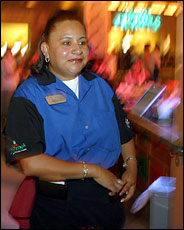
Ms. Diaz arrived illegally, but she eventually obtained a green card and citizenship through her father, who had been granted amnesty. For years, he had worked at a carwash in Los Angeles. Today, her whole family – parents, two sisters and five brothers – lives in Los Angeles. Once in Las Vegas, Ms. Diaz took a series of nonunion housekeeping jobs that she did not love, at a Best Western hotel, at Binion’s Horseshoe Casino, and finally at the luxurious Venetian. “In the hotels, the hardest job is housekeeping,” Ms. Diaz said. “It’s really hard when you come, and you don’t know the language. You want to be somebody, but it’s very hard.”
Two years ago, Ms. Diaz learned from the wife of one of her husband’s co-workers that there were unionized restaurant openings at the Luxor. Weary of making hotel beds and cleaning bathrooms, she landed a job busing tables at La Salsa. It paid $9.24 an hour, plus about $4 an hour in tips. The health plan was so good that she paid no premiums and made only modest co-payments. But Ms. Diaz had greater ambitions. After she passed the Culinary Training Academy course, she was immediately promoted to waitress. Now she is responsible for a half-dozen tables in the ocher-colored restaurant, which has the music of a Mexican crooner piped in. She greets customers with her big smile and tentative English, often recommending her favorite dish, the fajita salad.
As her status at La Salsa has risen, so has her pay. Las Vegas’s unionized busboys and waiters make the same base salary – $10.14 an hour, the highest rate in the nation. (By comparison, most waiters in New York City make $3.30 an hour before tips.) But waiters make much more from tips than busboys, who must be content with the often-meager amounts that waiters share with them.
 Josh Eidelson