A KICK IN THE TEETH

Rep. Rush Holt (D-NJ): “There are hundreds of thousands of Americans who have their arms, who have their eyesight, who have their lives, because OSHA has teeth.”

Right now in the House, the Republicans are pushing four bills to further weaken OSHA by making it easier for employers to put off responding to complaints, making it easier for the President to stack the commission, and limiting OSHA’s ability to aggressively interpret its laws. All this, of course, in the name of protecting small business. “Mom and Pop” companies, we’re asked to believe are wrongly aggrieved by the requirement that they notify OSHA within fifteen days should they wish to contest responsibility for conditions which cause serious injury or death for their employees. And we’re asked to believe, further, that the current law is unfair to all those small business owners who are injured simultaneously with their workers. Employers, of course, already have the opportunity to seek extensions in extraordinary circumstances; what Republicans want is to shift the responsibility to OSHA to prove why the deadline, which saves lives by facilitating rapid redress of unsafe conditions, should ever apply.

Rep. Major Owens (D-NY): “There is a class problem developing in America…What we’ve found in this war in Iraq, is that people on the top aren’t providing the kind of protection needed for people on the frontlines from working families.”

Truth is, there’s been a class problem developing in America, sadly, for a long time. It’s one we should be hearing about more often on the floor of the Congress and outside of it. And we’d be well served by more media attention to dangerous legislation like the bills under debate right now. But for all their claims to be looking out for regular Americans, you’ll notice that the Republicans aren’t hoping to see their handiwork on this issue in the news:

Rep. John Boehner (R-OH): “Let me remind my colleagues what this small, inocuous bill does…”

If a line like that doesn’t set off alarms, you haven’t been paying attention.
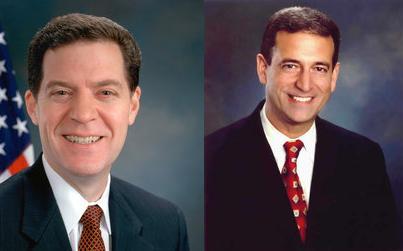
SEPARATED AT BIRTH, REUNITED AT THE FIRST DEBATE?

My hard-core jealousy of the people of Wisconsin for having the representation of Russ Feingold (D-WI) is no secret here. Neither is my (significantly diminished for ’08 in light of his recent divorce news, but still springing eternal) hope to see him run for President. If somehow he did seize that nomination, there’s a decent chance he’d be squaring off against another Senator, Sam Brownback (R-KS), who in the wake of Bill Frist’s filibuster semi-implosion and Rick Santorum’s likely ’06 defeat has an excellent claim to the loyalties of religious conservatives. A Feingold-Brownback face-off would be a delight to watch, not only because we would win, but because it would provide a real clash of alternative visions and ideologies which, if you haven’t noticed, is not the main thing for which US Presidential elections are famous. But it would also be memorable (remember, you heard it hear first) for another striking but as-yet un-remarked upon (until now) reason.

Russ Feingold and Sam Brownback look like the same person.

That’s right. What they lack in ideological similarity, they make up in similar appearance. Sam Brownback looks like a slightly more awkward, slightly less attractive Russ Feingold.

Don’t believe me? Decide for yourself:

Feingold and Brownback: You can tell their abortion stances apart – unlike their har-cuts. Just remember: You saw it here first.

LET’S REVIEW

In the wake of a vicious terror attack on American soil, the President of the United States, citing dubious intelligence “fixed around the policy,” led this country into a destructive and unjustified war war which has left Americans less safe than before.

When a US diplomat publicly disputed an intelligence claim later retracted by the White House itself, someone working for the President of the United States broke the law by leaking his wife’s identity as a covert operative to a reporter, blowing her cover in retaliation for her husband’s criticism.

Two years ago, the White House Spokesman told reporters that whoever made the leak would be fired, and that Karl Rove, now Deputy Chief of Staff, was “not involved in this.”

Yesterday, after revelations that Rove was a source for the story, and his lawyer’s weak defense that Rove didn’t mention Plame “by name” (Joseph Wilson only has one wife), the White House announced that it would refuse to answer any questions about the scandal, indefinitely, “as part of cooperating fully with the investigation.”

Among the journalists’ questions McClellan declined to answer yesterday:

Does the President stand by his pledge to fire anyone involved in the leak of a name of a CIA operative?

Do you stand by your remarks from that podium, or not?

When did they ask you to stop commenting on it, Scott? Can you peg down a date?

Can you walk us through why, given the fact that Rove’s lawyer has spoken publicly about this, it is inconsistent with the investigation, that it compromises the investigation to talk about the involvement of Karl Rove, the Deputy Chief of Staff?

Does the President continue to have confidence in Mr. Rove?

Has there been any change or is there a plan for Mr. Rove’s portfolio to be altered in any way?

I presume that the prosecutor did not ask you not to take action, and that if he did, you still would not necessarily abide by that; that the President is free to respond to news reports, regardless of whether there’s an investigation or not. So are you saying that he’s not going to do anything about this until the investigation is fully over and done with?

Who is Karl Rove as it relates to this current administration?

Now, are you concerned that in not setting the record straight today that this could undermine the credibility of the other things you say from the podium?

Scott, at this point, are we to consider what you’ve said previously, when you were talking about this, that you’re still standing by that, or are those all inoperative at this point?

When the leak investigation is concluded, does the President believe it might be important for his credibility, the credibility of the White House, to release all the information voluntarily that was submitted as part of the investigation, so the American public could see what the — what transpired inside the White House at the time?

Scott, was it — who in the investigation made this request of the White House not to comment further about the investigation?

Yes, in your dealings with the special counsel, have you consulted a personal attorney?

These are questions we all deserve to have answered.

MURDER IN LONDON

Thursday, my Mom and I watched the news of the attacks in London just before each heading off for out-of-state trips, by airplane and train respectively. Four days later, the Times reports on the limited progress of the intelligence investigation, and the Guardian offers an account of the limited progress of the recovery effort:

They could only begin to guess the full horror of the work going on in the tunnels directly underneath them as teams endeavoured to retrieve the bodies or the remains of those who still lie among the mangled wreckage of the Piccadilly line tube train. Rescue workers battled with temperatures which were rising above 60C (140F) in their attempt to retrieve all those who had fallen victim to Thursday’s bombs within 48 hours. As well as the heat, rats, dust and the risk of contamination from asbestos have all hampered the operation. Besides this, there was initial concern that the tunnel might collapse. Refrigeration units stood near the scene to store the bodies – and body parts – before they were taken to a temporary mortuary at the barracks of the Honourable Artillery Company in the City. Scotland Yard’s senior identification manager, Detective Superintendent Jim Dickie, said the extreme heat was a “significant factor” in the recovery operation between King’s Cross and Russell Square tube stations. The affected carriage is about 100ft below the surface. The space is so small that only a limited number of rescuers can work inside the tunnel at any time and teams have to return to the surface periodically, so harrowing are the conditions, which one rescue worker described as “hell on earth”. Deputy Chief Constable Andy Trotter, of British Transport police, warned that it would be some time before the “methodical and meticulous” but “extremely difficult” recovery operation was finished.

In the wake of the murders in London, the burning question, as Ivo Daalder reminds us, is not how we best exact retribution but how we reach the point which our current leadership has done so much to further distance – the defeat of Al Qaeda:

What the bombing did is to remind anyone who needed to be reminded that the job of destroying Al Qaeda remains undone. The Iraq War is a major reason why we have not succeeded — it has been a giant distraction (in terms of manpower, intelligence, energy, money, and high-level attention) from this essential task…When the right advocates “retaliation” it has in mind not Al Qaeda, but a state (Iran and Syria, mostly)…Even after London, they still don’t get the threat we face — which is why they call for retaliation whereas we call for getting back to the main business of destroying Al Qaeda.

But as Nathan observes, a full commitment to peace and security demands a longer-term perspective:

The best way to fight terrorism is to drain the pool of public support. Supporting the victims of the Tsunami in Indonesia was one of the best ways possible to improve the image of the US in that country. A serious commitment to aid in Africa, aside from being the right thing to do, is the best use of money to fight terrorism as well. If we took the money wasted in Iraq, we could build global support and allies around the world through a crusade to end poverty, even as we’d have additional money to secure our vulnerable facilities against the crazies left over. London shows our current strategy has failed. Let’s try a new one build on global justice abroad and intelligent security at home.

FLIP-FLOP IN A PHRASE

Appearing on Hardball, What’s the Matter With Kansas star Sam Bronwback (R-Kansas) just told us that Americans are angry at the courts because they keep “inserting themselves” in issues where we don’t believe they belong, like Roe, and “changing our understanding” of issues like property in cases like Kelo. What he avoided saying, lest he stray off the message discipline reservation, is that the decision in Kelo he decries as a change was a decision not to overturn the law. Senator Brownback’s problem with the court’s economic jurisprudence, in other words, is that it’s not activist enough.

The conservative establishment vision for the court is not that it leave controversial decisions to be settled directly by the people, but rather that it step back when majorities choose to legislate against civil liberties (especially those of others) , and then aggressively intercede to overturn even those economic regulations which are overwhelmingly popular. Conservatives like Sam Brownback are outraged when the court stops a heterosexual majority from writing homosexuals out of the city’s non-discrimination laws in Romer, but elated when it turns back Congress’ attempt to keep firearms out of our schools. Whereas my reactions, unsurprisingly, are the opposite. A couple days ago I set forth a couple of the reasons I think the Court is justified in blocking the imposition of majoritarian sexual morality in Griswold and unjustified in blocking the majority’s attempt to set common labor standards in Lochner (if you want to have sex without condoms and make at least $5 an hour at work – not at the same time that is – my using condoms doesn’t make a difference to you but my working for $1 does). And Brownback has his reasons for his position as well. But unlike, say, Nathan Newman, he can’t hope to credibly claim that he’s an opponent of “judicial activism” across the board (and unlike – maybe – Finnegan, he can’t claim to be a consistent fan of judicial intervention to limit government either).

As a couple Yalies just showed in a Times piece identifying Clarence Thomas to be the Court’s Activist-in-Chief, the question for most of us is when and to what extent such activism is just and appropriate, and the country would would be better served by a national debate on that question (personally, if the question were all the activism or none of it – which I’m glad it isn’t – I’d go with none so that the left would at least have recourse to the legislature, and a spur to organize).

WAL-MART VERSUS THE DISABLED

It’s not just folks who care about workers’ rights, women’s rights, racial equality, environmental stewardship, fair trade, free speech, or responsible development who have issues with Wal-Mart. The world’s largest retailer is also bad news for those of us who believe in the Americans with Disabilities Act. As this Daily Kos diary reminds us, the company was ordered in Feburary to pay 7.5 million dollars in damages to Patrick Murphy for reassigning him based on his disability. Now the New York Law Journal reports that the judge has cut the damages by $4.7 million to reflect the $300,000 cap on punitive damages under federal law. Judge Orenstein observed that within the limits of the law, it’s impossible to charge Wal-Mart enough to actually have the deterrent effect that punitive damages are supposed to:

“The preceding ruling respects the law,” Orenstein wrote, “but it does not achieve a just result.”…”There is no meaningful sense in which such an award can be considered punishment,” Orenstein wrote, pointing out that Wal-Mart had $300,000 in sales every 37 seconds last year…Orenstein said that Wal-Mart would not be deterred by the amount of punitive damages. He found that in dealing with Brady, the company had not adhered to a consent decree it entered into with the Equal Employment Opportunity Commission in 2001 requiring it to train managers and change hiring practices. “The most generous conclusion I could draw … was that the Wal-Mart employees who testified are well-intentioned people whom the company willfully failed to provide with sufficient training to abide by the anti-discrimination law,” Orenstein wrote. “The result,” he concluded, “was that Brady was subjected to the kind of discrimination against the disabled that both the law and the prior consent decree was designed to prevent.” The $300,000 punitive cap, he held, “appears unlikely … to restrain Wal-Mart from inflicting similar abuses on those who may be doomed to follow in Brady’s footsteps.”

Next time you hear someone arguing that arbitrary caps on the freedom of juries to assign punitive damages will protect the little guy against hordes of greedy trial lawyers, remember Patrick Murphy. And remember whoever becomes the next victim after Wal-Mart concludes once more that in the long run, discrimination is cheaper than equal opportunity.

FREEDOM MEANS FREEDOM FOR EVERYBODY

Yesterday the General Synod of the United Church of Christ (you may remember them from their too-controversial-for-TV ads last year celebrating non-discrimination in church) made history by passing the first resolution by a Mainline Protestant denomination endorsing equal marriage rights for all couples:

It was both a theological statement and a protest against discrimination, said the Rev. John H. Thomas, the president and general minister of the denomination, which has 6,000 congregations and 1.3 million members. “On this July 4, the United Church of Christ has courageously acted to declare freedom, affirming marriage equality, affirming the civil rights of gay – of same-gender – couples to have their relationships recognized as marriages by the state, and encouraging our local churches to celebrate those marriages,” Mr. Thomas said at a news conference after the vote by the General Synod.Hector Lopez, a minister from a small Latino church in Southern California, said he was not at first enthusiastic about same-sex marriage. But after officiating at about a dozen such ceremonies in Oregon and seeing the respect and commitment of the couples, he said, “I experienced a passionate conversion.”…His hope, [Thomas] said, is that “we will not run from one another, because if we run from one another we run from Christ.”

Check out the General Synod’s blog here. You can hear the Rev. Chuck Corrie’s sermon on Matthew 11 and the challenge of “discerning God’s will on difficult issues” here.

The UCC’s statement of conscience echoes the one celebrated in this obituary for Rabbi Louis J. Sigel, a driving force behind Teaneck, New Jersey’s voluntary school integration, the first such decision by a township in this country. As the author, paraphrasing Reginald Damerell’s book, writes:

Rabbi Sigel – a Torah and Talmud scholar who primarily considered himself a teacher – calmed a fractious community meeting. A law professor who was a member of Temple Emeth stood and asked why the whole community had to be “disturbed” by a problem that he said black residents had created themselves by moving into one end of town. “The temple’s rabbi, Louis J. Sigel, rose,” Mr. Damerell wrote. “His rich voice carried throughout the auditorium” as he narrated a story from the Talmud about a man who sees a fire in another part of town and asks, “What have I to do with the needs of the community?” “Sigel’s voice rose in emphasis, ‘Such a man destroys the world!'” Mr. Damerell wrote. “Applause exploded through the auditorium.” That set the stage for a resolution from the floor commending the Board of Education “for studying possible ways to prevent de-facto segregation,” the author said. It passed, thus providing the integration side with a victory in its first skirmish. Because of his pro-integration stand, some temple members wanted to oust him, his family later acknowledged, but a large majority supported him.

Recognizing that the bush is burning without being consumed, our tradition teaches, gives us the hope to pursue liberation. But it isn’t realized until we recognize that our liberation is tied up with that of our neighbors – that our homes are not secure as long as theirs are on fire.

THE RIGHT WAY TO HONOR THE 4TH

is to extend the reach of Americans’ constitutional freedoms by enfranchising those who’ve had their civil rights wrongfully stripped from them over prior felony convictions. That’s exactly what Iowa Governor Tom Vilsack has done in an Executive Order which goes into effect today. Now tens of thousands of Iowans (a quarter of whom are Black, though only a fiftieth of the state is) have the chance to exercise that most fundamental franchise, one which fosters opportunities to fight for the all too many others whose realization in this country remains deferred or denied. As the Des Moines Register wrote:

It is the right move. Convicts who have served their time should not forfeit such a fundamental constitutional right…Vilsack’s announcement, which came out of the blue Friday afternoon, stunned even close observers of the issue. It also angered critics, including Republican state legislators who saw it as a political calculation to add 50,000 or more likely Democratic voters to the rolls. Perhaps, but that sounds like support for denying ex-convicts constitutional rights to maintain a Republican edge in numbers…restitution [to victims] should eventually be paid in full, and the state has many tools at its disposal to push for compliance. The toolbox should not include denial of constitutional rights, however. The inability to vote is a visible brand ex-felons bear that labels them social outcasts, increasing the risk they might commit new crimes. The sooner convicted felons are allowed to participate in this civic responsibility, the better their odds of leading successful lives.

THE WRONG WAY TO HONOR THE 4TH

is to narrow Americans’ constitutional freedoms by amending the first amendment to ban unpopular symbolic speech. It’s disturbing to see the Senate within a few votes of following the House in passing the abysmal “Flag Burning Amendment.” And it’s disappointing to see so many Democrats (Bob Menendez, Sherrod Brown, and Loretta Sanchez among them) joining the pandering parade.

As I said in this piece (also here), crimminalizing flag-burning is a desecration of the flag and of our freedoms. As Hendrik Hertzberg once observed, it’s impossible to burn the flag, though some may choose to burn a flag or two. Trampling the freedoms for which that flag stands, however, is all too feasible.

That’s exactly how we should recognize the criminalization of a symbol based on offense at its content. After all, if the burning of a flag can be rendered illegal on grounds of outrage at the message it signifies, why not images of burning flags? Why not incitement to burn flags? Why not Dick Durbin’s insistence that torture is more befiting a despotic regime than the United States of America? There was a moment in this country’s history before the First Amendment when representatives on the floor of Congress had a constitutional right to free speech unavailable to regular Americans. It would be shameful for us ever to enter a moment after the unamended First Amendment in which the same is the case.

A Flag-Burning Amendment would still be outrageous if flag-burning was an everyday occurence in this country. But it’s worth noting that it isn’t. Not only was the pro-amendment Citizens Flag Alliance only able to document four incidents this year (three of them last month, while the Amendment was under debate and in the news), every single one involved people burning other people’s flags. However one ranks the wrongness of setting the local Public Library’s flag on fire relative to, say, denying healthcare to returning veterans, it’s already illegal.

What’s at issue is this: Living in a society with a robust Bill of Rights means that in some rare instance, some American may exercise the freedom granted under our flag to burn a flag in hopes of dramatizing a divide between a vision for this country and its present reality. The discomfort that’s inspired by a burning flag, or a confederate flag, is a small price to pay for liberty.

CHANGE TO WIN ROUND-UP

On Thursday, the Change to Win unions released twenty resolutions they’re submitting for votes at the AFL-CIO’s convention at the end of this month. Echoing the dissidents’ May platform, these amendments would commit the Federation to rebate dues to unions prioritizing new organizing, empower it to demand accountability from unions which aren’t and facilitate strategic mergers, and strengthen the power of the most populous unions with the AFL-CIO’s decision-making structure. They would commit the federation to aggressively promote internal diversity, international solidarity, and responsible budgeting. They would commit the federation to foster cooperation and the maintenance of bargaining standards within industries and solidarity across the movement in fighting for retirement security, universal healthcare, and global justice. And in defiance of the threats Sweeney’s issued should the dissidents split off, one of their resolutions would open central labor councils to the participation of non-AFL-CIO unions.

Given that Sweeney has the votes locked down for re-election (though a few are speculating he could still be pressured into bowing out), the debate and voting over these resolutions is likely to be the greatest flashpoint for controversy at the federation’s most contentious convention in a decade. And what happens to these resolutions will be crucial to determining whether the dissidents continue to pursue their agenda for change through the federation or whether they make a break.

As the Change to Win unions consider their next move, they’ve been joined last week by the Carpenters, who formally affiliated with Change to Win four years after themselves splitting off from the AFL-CIO over similar concerns. The Change to Win dissidents have played a key role in keeping the pressure on to stop Sweeney from forcing the Carpenters out of participation in the federation’s Building and Construction Trades Department, and the Carpenters were players in the New Unity Partnership as well. Their affiliation is no surprise, but it does help to further swell the new coalition and puts front and center the model of a union which has experienced success since breaking away from the AFL-CIO. The real coup for the dissidents would be pulling in the National Education Association (NEA).

All of this friction, though certainly tense, has the potential to transform a movement and a set of organizations sorely in need of it, and turn around the decline in American union membership which has steadily pulled the efficacy of the broader left down with it. But don’t take it from me – take it from the prestigious anti-union law firm Morgan Lewis:

If the Coalition’s members follow through on their threats to disaffiliate from the Federation later this year, employers can expect an increased interest in union organizing. This could be especially true for the nation’s largest non-union employers. For employers with existing unionized workforces, this means increased pressure to execute some form of neutrality and card-check recognition agreement. For employers with unions from both competing factions at their facilities, competition for better wages, benefits and other terms and conditions of employment is likely…the raiding between AFL and CIO constituent unions that occurred prior to 1955 will now play out between Coalition’s members and those remaining loyal to the Federation. The last several years have seen a significant increase in the amount of collaboration between U.S.-based unions and their international counterparts. That collaboration could increase significantly. Finally, more union mergers should be forthcoming.

SEEKING SOLAR SOLIDARITY

Nathan offers a good example of what a missed chance to build a broad-based pro-environmental constituency looks like:

California is debating a Schwarzenegger-backed bill to subsidize solar panels on homes and businesses across the state– on a level that could supply energy equivalent to 10 average-sized coal-fired power plants. Sounds good, but in a classic move to pit labor and environmental interests, the GOP cosponsors, as this article details, oppose a requirement that public money only go to installers paying prevailing union wages in the state. Labor in California has fought a long struggle to require that, if government pays for it, the labor has to meet union wage levels. Now, the GOP wants to open a multi-billion dollar loophole in the rule: somehow the hipness of solar panels makes using public money for sweatshop labor acceptable. This is a perfect chance for environmentalists to stand up for the principle that green policy can also be a pro-labor policy, but few environmental leaders have stepped up to champion prevailing wages for the workers who would actually install all these solar panels across the state.

It’s this kind of failure build not just a momentary majority but a stable, inter-generational, cross-cause constituency that caused some environmental leaders last year to declare “The Death of Envionmentalism.” Of course, where Nathan says,

And the enviros wonder why some labor unions joined the GOP in supporting drilling in ANWR when they promised that all those jobs would pay union wages

one could with equal justification fire back “And the union people wonder why some environmentalists are willing to screw them to get solar energy in the wake of ANWR.” The stakes for both movements – fostering an alternative to a laissez-faire race to the bottom and building an economy which values and invests in human beings and the earth – are too high not to work together. Everyone has on the left has some work to do to get their own house(s) in order. If you want to see what the payoff from broader-based, cross-issue organizing looks like, just check out the modern Right in this country.

OVER HARM THEY CREATE/ WE SHOULD ALL BE IRATE

This spring, I had the chance with a group of concerned Yale undergrads and graduate students to meet with K. Geert Rouwenhorst, the Chair of Yale’s Advisory Committee on Investor Responsibility, the body which advises the Yale Corporation on ethical investing (among its weaknesses, the body doesn’t actually have any access to information on the majority of Yale’s investments). We were calling on ACIR to convene to critically assess Yale’s investment in Compton Petroleum’s bid, under debate at the time before local government, to dig sour gas wells in Alberta without a sufficient evacuation plan in the case of a hydrogen sulfide leak. Unfortunately, contrary to the New Democrat Party’s David Eggen stated confidence that “Yale will agree and as a shareholder will want to put people over profits,” ACIR declined to act. The most memorable part of that meeting, not only for the rhyming and meter but also for its unintentionally ironic encapsulation of the weakness of an all-too common regulatory model, was this quote from Professor Rouwenhorst, “If it’s still being debated, no social harm has been created.” The catch-22 here is clear: No regulation to avoid social harm is possible until after there’s been social harm.

Sadly, as Phoebe points out, right now another oil company which claims Yale as a significant investor is providing an all-too vivid example of what that social harm looks like. As Qatar’s Gulf Times reports:

Bangladesh is losing huge sums worth 6mn taka ($100,000) a day as the blaze at the Tengratila gas field in Sunamganj district continues despite a heavy rainfall. Reports said it was gradually going beyond control. Sources said Niko, the Canadian oil exploration company exploiting the field, did not take any step to extinguish the fire even after five consecutive days of the second blow-out at Tengratila gas field. World famous Canadian gas experts like Bob Merge and Milan, who reached the site two days ago, failed to control the fire and did not give any solution to Niko in this regard…It will take 10 to 15 more days to start drilling of a new relief well. The whole matter depend on Unocal’s rig, officials said.
The Tengratila gas field inferno is spewing out flames as high as 250 feet, burning about 50 to 60 mmcf of gas worth 6mn taka daily and causing unprecedented environmental disaster. “We have no idea when it would stop”, Mahmudur Rahman, adviser to the Energy Ministry said after visiting the Tengratila blow-out area. He said, “We need to ‘kill’ the well first, which means we have to dig a relief well first, and how quickly we do it is crucial; it needs time to procure a rig.”

The blow-out has also caused tremor in the area damaging houses and forcing panic-stricken people to leave their homes. The accident site presents a dismal picture of shrivelled or burnt leaves on the plants. The local residents are bracing for the worst…The energy adviser said that help of Unocal, a US company operating in the country’s three other gas fields, would be sought to bring the flames of Tengratila under control…Local experts say even if the rig is procured time would be needed to start the work on the relief well at Tengratila. “To design a relief well pad involves tough and huge engineering work and if it is designed in a hurry then another accident might occur,” they opined.

Below is a photo of another gas well leak in Tengratila from January. Maybe this is the point where ACIR could take an interest?