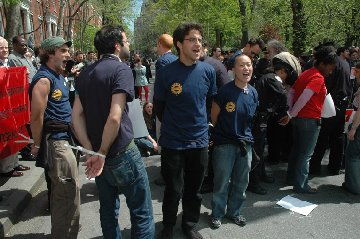
SIGN OF THE TIMES?

Never in the history of Nebraska’s third congressional district has it been represented by a Democrat. How nervous are Republicans about losing the seat to Scott Kleeb in November?

They’ve sent Dick Cheney to campaign there.

Besides boding well for Democratic electoral fortunes, this news is also comforting because it gets Dick Cheney out of Washington, which should limit the damage he can do for a day. Unless he shoots someone in the face.

THE SILENT PRE-PRIMARY

The past few weeks, with Hillary Clinton’s formal acceptance of the Democratic party endorsement for Senate and an ensuing wave of articles about her politics and personal life, have brought speculation about the Democrats 2008 primary and the role that she will play in it. The emerging conventional wisdom consensus of today seems to be that she’s much less popular with party activists than was assumed in the conventional wisdom of yesterday, but that denying her the nomination would require an “Un-Hillary” capable of clearing the field of other viable aspirants and gathering together the disparate constituencies that don’t want to see her as the party’s standard-bearer in the next Presidential election. What the pundits seem to disagree about or, in many cases, ignore entirely, is whether that alternative candidate will come from the left or from the right of the Democratic party.

Since pundits and party hacks are likely to force the narrative of the coming primary into either a “Hillary versus the Un-Hillary” mold or a “Hillary versus a slew of guys” one – the latter of which pretty much secures her the nomination – who emerges from the primary will turn in some significant part on how the part of “Un-Hillary” is scripted. What kind of candidate the “Un-Hillary” is supposed to be will help determine who gets to seize the mantle and get the attention and the activists that make it possible to win. And what kind of candidate the “Un-Hillary” is supposed to be will depend in good part on who Hillary herself is perceived to be: the ostensible feminist firebrand committed to subversion of culture and nationalization of industries, or the hawk who’s proud to have voted for the war and wants government to regulate video game content more and credit card interest rates less. Evan Bayh and Mark Warner are running against the former; Russ Feingold and John Edwards are running against the latter.

So while the ostensibly-right-of-Hillary majority of Democratic presidential aspirants are each other’s immediate competitors for the right-of-Hillary niche, they are also allies in working to ensure that Hillary is seen as a left-winger who could be stopped by a right-of-Hillary “Un-Hillary” and not a right-winger who could be stopped by a left-of-Hillary “Un-Hillary.” The opposite is true of the minority of Democratic presidential aspirants who are gunning to run to her left.

Which camp will get the Hillary they want? The right-of-Hillary folks still have the media largely on their side, in that even the increasingly publicity around her moves to ban flag-burning and such still frames these acts as feints to the right by a unreconstructed liberal with the political savvy to disguise herself (this coverage often pivots around the myth that “Hillarycare” was a solidly left-wing proposal). The left-of-Hillary folks have Clinton herself on their side – both the conservatism of her record on the issues that divide the party and the intensity of her campaign to highlight her centrism. Judging by the approach she’s taken (with exceptions on some votes on seemingly forgone conclusions, like Bush’s nominations), as well as the comments of her advisors, she seems much more concerned with protecting herself from the right-of-Hillary competitors than from the left-of-Hillary ones.

Last month, Jonathan Chait noted the bind Clinton is in: “instead of moderates focusing on her positions while liberals focus on her persona, the opposite seems to be happening.” The logic of her circle seems to be that her gender, her rhetoric, and the relentless multi-decade assault on her from the right will be enough to secure the support of the left even as she offers policies to woo the center and beyond. If she succeeds, then progressives will be confronted not just with the comparatively conservative Clinton as frontrunner but with the comparatively conservative Clinton as the leftie of the crop of frontrunners. But given the increasing anxiety about her amongst the Democratic base, there’s reason to hope she won’t.

NOT ON OUR WATCH

Ever since the anti-war rallies in 2002, I’ve been somewhat anxious about the “Not in Our Name” slogan. I certainly agree that those who can do so safely have a moral responsibility to speak out against injustice whether or not the immediate impact of that speech is clear. But I think the “Not in Our Name” rhetoric has a way of shifting the focus away from using mass mobilization to avert catastrophe and towards insulating one’s self from future responsibility for catastrophe. I don’t think it’s a stretch to hear in chants of “Not in Our Name” a grudging resignation that war will be conducted in someone else’s. That the Iraq War took place, and continues, is a reality for which all of us with the privileges and burdens of American citizenship bear some measure of responsibility. So while I think it’s good and reasonable for Americans at home and abroad to share their opposition to the Bush administration, the eagerness with which some on the left have embraced “Don’t Blame Me – I Didn’t Vote For Him” bumper stickers and buttons seems to evince too much pride in personal purity and too little sense of personal responsibility.

This is why I was glad to see the Save Darfur Coalition take on the slogan “Not On Our Watch.” While I do believe that we have a particular responsibility to avert crimes perpetrated by our own government, I’m glad that a comparative lack of concern with allowing the Darfur genocide to be perpetrated in our names led the coalition to instead commit to stopping it from transpiring on our watch. “Not On Our Watch” acknowledges a common moral responsibility for the crimes which take place within communities large or small of which we are a part. When Americans take to the streets to avert a war with Iran, it would make a worthy slogan.

BEDROOM POLITICS

Last year, Grover Norquist told a New York Times reporter that he had little trouble getting the culture warriors over at the Eagle Forum to stand with the auto industry in opposition fuel efficiency standards because “it’s backdoor family planning. You can’t have nine kids in the little teeny cars.”

Certainly, leaders on the modern American right, as well as the left, struggles with how to keep its constituent movements working constructively together, or at least keep them from actively undercutting each other. But those struggles seem to turn out better on the right. Arguably, that’s because the right has real power to mete out amongst the groups and individuals who make it work and can therefore keep them in line. But there’s as strong a case to be made that being out of power is more unifying – that’s why, in the fall of 2004, well-justified and broadlyy shared anti-Bushism made it so much easier to imagine that there really was a coherent, unified left in this country. That example itself suggests one of the problems we face: while there’s more discussion these days about the importance of broad-based, multi-issue progressive coalitions, the people most vocally pushing for them want such coalitions to work essentially as extensions of Democratic Congressional and Senate Campaign Committees. “Netroots” folks like Kos actually pride themselves on their lack of ideology (and get vouched for on this count over at The New Republic).

Meanwhile, while a certain amount of the hand-wringing on the right about Bush’s supposed unconservatism is just a strategic response to his unpopularity – that is, an attempt to save the conservative brand from public dislike of its most prominent example – there is a genuine gap between certain aspects of what Bush is doing and the preferences of the grassroots activists and house intellectuals of the conservative movement, and it seems to be spurring renewed consideration at least in the pages of the right-wing mags about whether there can be a multi-issue conservative ideological coalition that’s not a partisan one. If conservatives do a better job than liberals of organizing across issues for a vision beyond the electoral fortunes of a party, even as conservatives and not liberals are running the government, then the left will have been outmaneuvered again.

That’s why folks across the left should be excited about UNITE HERE’s Sleep With the Right People campaign, part of the union’s international Hotel Workers Rising project, through which hotelworkers in cities all over North America are using concurrent contract expirations to leverage strategic pressure on major hotel chains to raise the standard of living for all their workers and agree to fair organizing conditions for those without collective bargaining rights (I start work with HWR tomorrow; views expressed here are my own). Sleep With the Right People represents a crucial alliance of progressives committed to the dignity and empowerment of people too often marginalized based on sexuality, class, gender, race, or the intersection of these identities.

As Hugh argues here and here, this campaign represents a critical stand against the view that “difference” should be “a cause of fear.” It recognizes the interconnectedness of the freedoms to join a partner in building a life together, and to partner with co-workers to build a more democratic workplace, each without sacrificing safety from violence or freedom from want. It’s a step towards the ameliorating the too-frequent insensitivity of the labor movement towards identities other than class and the too-frequent insensitivity of the LGBTQ movement towards identities other than sexuality. There are more steps ahead.

ANYBODY CAN SERVE

Anya Kamanetz has a great piece in the Times criticizing the role of unpaid internships in reinforcing inequality and discouraging assertion of material needs by employees and future employees. As she observes, these internships, because they require taking an economic loss during the summer to pay for cost of living while receiving no wage, function as a luxury good available largely to the already privileged – and at the same time, they serve as crucial qualifications for future employment. So they make it easier for the most fortunate among us to stay that way (inadequate financial aid systems are part of the problem as well). And at the same time, these internships support the sense that if you truly care about something, you shouldn’t care about getting paid for it. Which is easier not to care about when you don’t need the money. As Dana Goldblatt observed, “By letting myself be exploited, I’m actually exploiting others.”

Over at Campus Progress, Asheesh notes that progressive organizations are often stretched thin as it is. That’s indisputable. But the unwillingness of so many groups on the left to economically support those potential summer interns who can’t work for free evidences a failure to take a long-term strategic interest in building our base and diversifying the leadership of our movements. And it’s an unfortunate example of the lack in many corners of the modern American left of a systematic account of class and the role it plays in modern American life.

That problem was all too clear when I asked the president of a leading environmental group why the movement wasn’t more diverse and she responded that her group could only recruit “joiners.”

It’s also clear in the valorization by many on the left of an ethic of volunteerism as the ultimate foundation of civic life. I’m all for community service. But statements that make unpaid service out to be the most noble of activities obscure this country’s dependence on the men and women who do critical work for long hours teaching children and caring for patients and serving food and get paid (though not enough) – because if they weren’t being paid, they couldn’t provide for themselves and their families. Volunteerism, as it all too often gets discussed, is a classed ideal, and its valorization to the exclusion of other forms of service leads us to identify as community leaders primarily wealthy people who make contributions that require little sacrifice.

Absolutely, everyone should seek ways to use their time away from work to reduce injustice – though having students clean the windows of public schools together once a year is a less effective way to do that than having them get together and try to figure out why no one in their community is being hired to clean the schools’ windows and how that should be changed. But whether it’s community service or political advocacy, progressives do a disservice to our values and to our community when we valorize first the work that doesn’t pay (this is part of why I’m so excited about Students for a New American Politics).

In high school, when I led our school’s contingent to Philadelphia’s Martin Luther King Day of Service, we got T-shirts with Dr. King’s quote that “Everybody can be great. Because anybody can serve.” King was absolutely right. But his point is often misunderstood. “You don’t have to have a college degree to serve,” he continues, “You don’t have to make your subject and your verb agree to serve. You don’t have to know the second theory of thermo-dynamics to serve. You only need a heart full of grace. A soul generated by love.”

King’s words are a much-needed reminder that we can best overcome divisions through shared projects of social justice. Unfortunately, just as imposing professional qualifications on service would render the ideal inaccessible to many people, imposing the requirement that service be uncompensated to be laudable reinforces already existing divisions. So does the claim made by too many liberals that social justice is about selfless acts for others by those with nothing to gain themselves. Such a definition will always privilege those who have less stake in their struggles and obscure those who take tremendous risks to fight for a stronger community for themselves and their neighbors.

DEEP FREEZE

The past week has offered the odd spectacle of Nancy Pelosi and Dennis Hastert standing shoulder to shoulder in defending a Democratic congressman’s supposed right not to have criminal investigators raid his office. On the law, I think they’re on the wrong side. As Akhil Amar (whose lecture was one of the only courses my bro and I took together) writes:

W.J. is a target of a criminal corruption investigation, and if criminally charged, he would have no more Arrest Clause protection than any of the countless other sitting Congress members who have been criminally prosecuted over the years—Dan Rostenkowski, Duke Cunningham, and Tom DeLay, to name just three. Since W.J. has no immunity from an ordinary criminal arrest, it is hard to see why he has some kind of blanket immunity from an ordinary criminal search to uncover evidence of his suspected crime. If other white-collar suspects are vulnerable to office searches, why is William Jefferson any different?

In terms of political strategy, Hastert’s move (and the zeal of Sensenbrenner et al to follow him) is noteworthy because Jefferson’s case was the only one (contra John Solomon) offering serious ammunition for the Republicans’ claim that the current crop of corruption is a bipartisan problem. Had Hastert and company wanted, with a media establishment all too eager to expound on the “everybody does it narrative,” they could have a primed a whole raft of stories this week to the effect that Democrats and Republicans both have to get their houses in order, and the only difference is that the Democrats’ house includes a refrigerator with $90,000 hidden inside. That claim is bogus (and it’s worth noting that Jefferson is as “New Democrat” as they get), but it would have gotten traction nonetheless.

So the Republican leadership could not have passed on it lightly. Apparently, they decided that a week of reinforcing the idea that Democrats are equally corrupt was worth less than a week of reinforcing the idea that members of Congress have the right not to be aggressively investigated. The fact that of the two opportunities, the Republicans chose to spend this week lying the groundwork for the idea that congressmen have special privacy rights (and seeming civic-minded for throwing a fit in defense of a Democrat) suggests that they expect a slew of additional Republican congressmen to come under investigation. And chances are they’re right.

What’s harder to explain is Nancy Pelosi’s choice to get on board with the whole exercise. Presumably, she sees in this debacle a chance to exacerbate intra-GOP tensions and reinforce a narrative of executive overreach by the Bush administration. But when it comes to dividing the party on itself over raids like this one, she can only get in the way. And when it comes to taking a stand against executive overreach, the rights of congressmen are the last place the American people want or need the Democrats to assert themselves. As Barney Frank said on the floor:

I think, in particular, for the leadership of this House, which has stood idly by while this administration has ignored the rights of citizens, to then say we have special rights as Members of Congress is wholly inappropriate.

The Jefferson case, inconvenient as it is, allows the Democratic leaders to differentiate themselves from their Republican counterparts. Pelosi can and should condemn William Jefferson in terms that Dennis Hastert will never condemn Tom DeLay. That’s because the nexus of corporate interest and political power that does so much to breed corruption in Washington is one which undergirds the modern Republican party and which, for all the efforts of some Democrats to cozy up to it, is fundamentally opposed to the long-term interests of the Democratic party.

Pelosi did the right thing by calling on William Jefferson to resign. She could drawn a further contrast by coming out strongly against Hastert’s claim of special privilege for him. Just as Hastert has more credibility defending the supposed privacy rights of a member of the opposition, Pelosi would have more credibility denying those claims when applied to a member of her own party. Instead, look for Dennis Hastert to invoke the Jefferson precedent to call on Nancy Pelosi to join him in throwing up roadblocks to a full investigation of another crooked colleague – or perhaps of Hastert himself.

COME ON

The Times reports that 72 Georgetown faculty, administrators, and graduate students have signed a letter protesting the school’s hiring of Douglas Feith for a two-year lectureship. Which of the 72 did Jason DeParle choose to interview? One is the author of the petition. The other

has appointments in anthropology and French and whose résumé lists several writings about French chocolate makers. (“From Master Chocolatiers Today: Bayonne and the Basque Coast.”) She complained that Mr. Feith’s appointment was “presented as a fait accompli.”

What better to reinforce a narrative which marginalizes critics of the neoconservative project as anti-American elitists than an anecdote about a French professor who studies “Master Chocolatiers”? That liberal media, at it again.

Incidentally, Professor Terrio has other research papers DeParle could have cited, like “New ‘Savages’ in the Suburbs: Criminalizing ‘Immigrant’ Youth in French Mass Media.” Or he could have talked to a professor like Judith Tucker, the historian who edits the International Journal of Middle East Studies. But that wouldn’t pack the same narrative punch.

FIGHTING WORDS

Hugh Baran: “How can the LGBT community hold the Democratic Party to account when it continues to support candidates who vote against their interests?”

Stephan Goetz and Hema Swaminathan: “After carefully and comprehensively accounting for other local determinants of changes in poverty, we find that the presence of Wal-Mart was unequivocally associated with smaller reductions in family-poverty rates in U.S. counties during the 1990s relative to places that had no store.”

Jo-Ann Mort: “George Bush is waging a war in Iraq supposedly to bring democracy to the Middle East. That isn’t happening. But for the democratic left and progressives generally to be serious opponents of this war, we must be impeccable in our stance.”

OVERHEARD IN THE BATHROOM DURING LAST NIGHT’S ALDERMANIC MEETING ON YALE – NEW HAVEN HOSPITAL

“Man, after this I’m going to need to go home, go out on the deck, and smoke a cigar.”

“Yeah. I think I’ll go home and smoke a cigar in my hot tub.”

NYU, NYU, WHY DO WE HAVE A W2?

In the muckraking of tradition of the YaleInsider blog (when are we going to see some new content up there, by the way?) NYU students and NYU alumni now have a new resource to check out for a critical perspective on the latest NYU news: NYU Exposed.

We’ll see how well it can compete for rapid updates with Zach’s blog.

BETTER LUCK NEXT TIME (ON GOOGLE)

To those of you looking for…

bound gagged policewomen

slogans for a campaign for treasurer

wisconsin women strip clubs

anti-labour arguments

marriage of tom and shelly donahue in north carolina

halliburtons side of the story

…I’ve got nothing for you.

For those of you looking for real content on this site, there should be some next week after Tuesday, when I hand in my last paper for a very, very long time. If you missed the genuine, substantive content from my spring break, some of it is archived here, here, and here.

And for those of you still looking for pictures of Rosa Parks, well here you go.