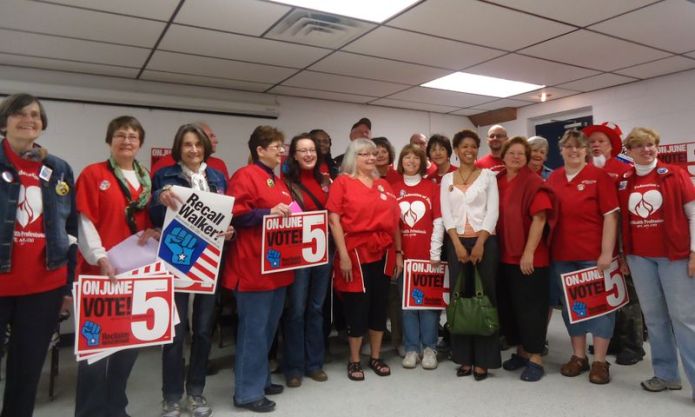
“PARENT TRIGGER”: THE LATEST TACTIC FOR FIGHTING TEACHERS’ UNIONS

At Salon:

The Wisconsin recall is now weeks past, but collective bargaining is still under assault nationwide. In cities and states across the country, public school teachers face threats not just to their benefits, but to their right to negotiate. And liberal Democrats are as likely as Scott Walker-style Republicans to be the ones mounting the attack.

Earlier this month, the U.S. Conference of Mayors held its annual meeting in Florida. It’s a diverse group, including leaders from both parties and all parts of the country. But it pulled off a unanimous endorsement of a pivotal piece of legislation: the anti-union education reform template proponents call “parent trigger.”

Check it out.

ON THE DAVID FELDMAN SHOW: APPLE WORKERS “WORK DIFFERENT”

David Feldman had me back on his show to discuss my reporting for In These Times on working conditions in Apple Stores, and the New York Times‘ new feature on the topic. You can listen to our conversation here.

HUNGER STRIKERS CHARGE CONGRESS WITH STARVING POSTAL SERVICE

At In These Times:

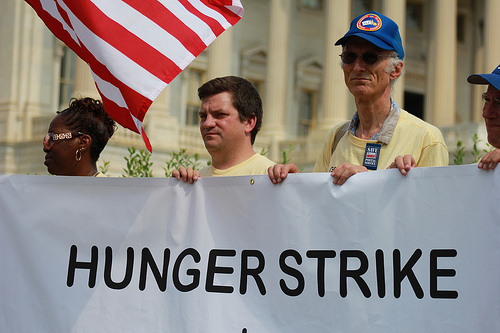
Since Monday, ten workers and consumers have been hunger striking on behalf of the embattled U.S. Postal Service. Their action comes amid a fierce debate over what ails the agency and how to fix it. “It’s a shame,” says hunger striker Tom Dodge, “to let something that’s so efficient and doing so well just die, starve to death.”

Dodge says he’s “amazed” to find himself on hunger strike. A 13-year postal truck driver in Baltimore and a member of the American Postal Workers Union, he says in the past he never got involved in union activism because of “too much politics.” Dodge describes being inspired to act following proposals for major cuts last year. But after participating in rallies coordinated by USPS’ four unions, he concluded they’d had only “a limited effect.” Reached by phone Tuesday while waiting to meet a representative from House Speaker John Boehner’s office, Dodge called the hunger strike “about the strongest thing you can do without breaking the law.” “We’re trying to shame them,” says Jamie Partridge, who recently retired after 27 years as a letter carrier in Portland.

Here’s the rest.

ON THE DAVID FELDMAN SHOW: WISCONSIN, POST-RECALL

Comedian David Feldman had me on his show to talk about what the Wisconsin recall means for labor, there and elsewhere, and to answer questions about what collective bargaining is and how it works. You can hear the audio here.

ON THE MATT FILIPOWICZ SHOW: WISCONSIN’S RECALL, OBAMA’S NAFTA

Matt Filipowicz had me back on his show to talk what defeat in Wisconsin’s recall means for labor and what new leaks show about Obama’s trade deal. You can listen to our conversation here.

ARE NURSES HEADED TO WAR WITH SEIU?

Breaking at In These Times:

On June 15, a day after a Service Employees International Union (SEIU) official asked labor leaders not to oppose a change to nurse-patient ratios, California Nurses Association (CNA) Executive Director Rose Ann De Moro sent a blistering e-mail to her colleagues: “It is a war, of that I am certain, and it will not be pretty.”

Questioning whether SEIU – United Healthcare Workers West (UHW) President Dave Regan “has any principles,” De Moro called him “dogged, arrogant and an enormous embarrassment to the labor movement.” De Moro, who directs both CNA and its national affiliate, National Nurses United (NNU), charged, “the hospitals believe that they have found a way to weaken the nurses and their union with Regan in their power, and this will lead to some pretty nasty scenarios for the nurses, patients, and of course the union.” (The e-mails were provided to In These Times by a labor source.)

Reading that e-mail – and the public invective that’s volleyed between CNA and SEIU since – it would be easy to forget that both unions are bound by a three-year-old peace treaty. And it would be fair to ask how long that “organizing partnership” – which has restricted CNA’s support for SEIU’s arch-rival, the National Union of Healthcare Workers (NUHW) – can survive. An interview with De Moro suggests that agreement’s future is in question, while previously unreported letters show the AFL-CIO rebuffing SEIU’s bid for a larger deal to freeze out NUHW.

Read it.
TEAMSTERS PUNISH LOCKOUT WITH ROLLING SYMPATHY STRIKES

At In These Times:

Over the past month, Teamsters in five cities refused work in solidarity with locked-out sanitation workers in Evansville, Indiana. The Evansville labor dispute is the second in three months to feature sympathy strikes against Republic Services. This rare tactic represents a major escalation in the Teamsters’ struggle with the company, and it’s poised to intensify this week.

As I reported for Working In These Times, Republic Services/ Allied Waste, the second-largest solid waste company in the United States, locked 79 workers out of their jobs six weeks ago. (Under U.S. labor law, when union contracts expire, companies can lock workers out, and either shut down production or bring in replacement workers to do their jobs.) Republic told workers they’d be locked out unless they accepted a “last, best and final“ offer that would eliminate their pensions and replace them with 401(k)s.

Check it out.

TRANS-PACIFIC PARTNERSHIP: LARGER THAN NAFTA?

At Salon:

President Obama campaigned in 2008 as a strong pro-labor candidate, and this year he will again. But for union activists who’ll be working hard for his reelection, a newly leaked document represents yet another bitter disappointment.

The document contains draft text of a chapter of the Trans-Pacific Partnership trade agreement currently being negotiated between the U.S. and eight Pacific countries. The Obama administration has shrouded the negotiation in secrecy, but the document, published by a coalition including the consumer group Public Citizen, sheds a light on the process — and the view isn’t pretty.

Check it out.

“NO JUSTICE, NO PIECE”: PIZZA COMPANY ACCUSED OF TARGETING IMMIGRANT STRIKERS

At In These Times:

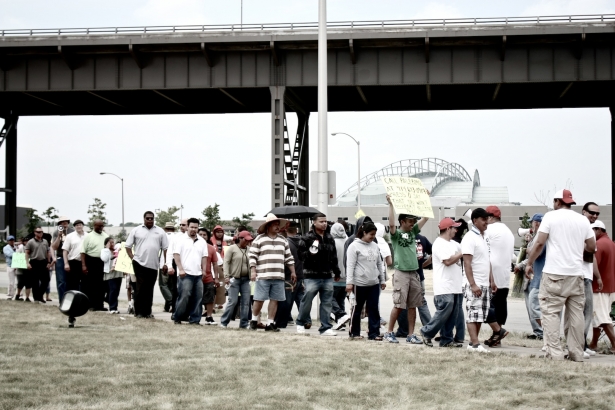
MILWAUKEE – Workers at Palermo’s Pizza have been on strike for two weeks. They say they chose to strike after Palermo’s met their efforts to form a union with threats and retaliation, including the use of immigration enforcement as a weapon. Slogans include “No Justice, No Piece.” On Monday, the National Labor Relations Board (NLRB) set a union election for July 6.

“We want Palermo’s to treat us as a person,” striker Orlando Sosa said as he picketed Palermo’s Milwaukee factory.

In interviews last week – some on a picket line, others following a Get Out the Vote Rally led by Jesse Jackson – Palermo’s workers said the strike was caused by years of abusive work conditions and weeks of anti-union intimidation.

Check it out.

CAN UNIONS BOUNCE BACK?

At Salon:

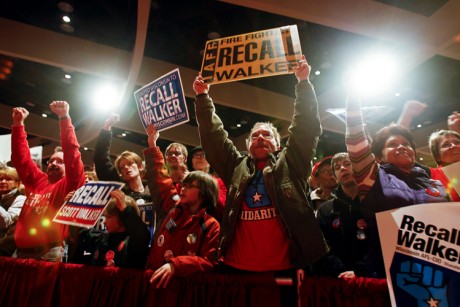
MADISON, Wis. – Last year, Wisconsinites reinvigorated the labor movement as they defied their union-busting governor. Last night, Wisconsinites voted to keep him in office. That result cements Wisconsin as the place that best captures both the vitality and the vulnerability of the current U.S. labor movement.

There’s much to mourn in last night’s result. What it reflects: the triumph of big money in politics and the traction of anti-union resentment. What it inspires: even more aggressive attacks from employers and politicians. What it cements: Public workers’ legal right to bargain will be anemic in Wisconsin for years.
At an election night party in Madison, the president of a New York union local told me Walker’s victory will inspire Gov. Cuomo to go even harder after his union. A Madison school nursing assistant told me it’ll drive her co-workers to leave the profession before their pensions are gutted. And people pondered why so many of their fellow citizens would side with a governor who’d promised to “divide and conquer” union members.

Check it out.

EMBEDDED IN THE TURNOUT WARS

At In These Times Tuesday:

MILWAUKEE- With most polls showing Democratic challenger Tom Barrett a few points behind Governor Scott Walker, Barrett’s backers are counting on outstanding turnout to secure an upset in today’s election. Several statewide organizations are deploying paid and unpaid canvassers in hopes that Walker’s opponents, who last year out-mobilized his supporters 100 to 1 at the capitol in Madison, can bring him down at the ballot box. During the past week, I followed canvassers from four groups – Working America, We Are Wisconsin, the Wisconsin AFL-CIO, and Organizing for America – in and around Milwaukee, the largest population center in the state.

“If Milwaukee comes alive,” Rev. Jesse Jackson told reporters before a GOTV rally last night, “Milwaukee is twice the population size of Madison. Madison’s come alive, as we’ve seen in the last several months. But if Milwaukee and Madison share a common interest…we can win this election.”

THE WOMAN WHO COULD SPOIL WISCONSIN

At Salon Tuesday:

For months, progressives have raised the alarm over what role Kathy Nickolaus, the nation’s most notorious county election clerk, would play in counting tonight’s Wisconsin recall results. Their fears were echoed by the pro-Walker editorial board of the Milwaukee Journal-Sentinel, which wrote in April that Waukesha County’s voting snafus on her watch had “damaged her office’s credibility beyond repair.”

In a closely watched judicial election in April 2011 – seen as a referendum on Scott Walker’s agenda – a seeming Democratic victory evaporated when Nickolaus announced she’d found 14,000 misplaced ballots from her deep-red county two days after the election. In April’s GOP presidential primary, issues with Waukesha County’s election computer system led to more delayed results, as paper voting slips were gathered from across the county and put up on the walls of an office to be counted.

Here’s the rest.