CAREER PATH TO MOTHERHOOD?

Tuesday’s New York Times piece on women at schools like Yale who plan to become stay-at-home moms addresses an important phenomenon. Unfortunately, it makes little more than passing mention of the underlying issues of class and gender which shape the choices the article pitches largely as curious lifestyle decisions.

Class divisions deeply inform women’s and men’s decision about parenting in work in multiple ways. They make it possible for some women to picture living and raising children comfortably off of the income of an exceptionally well-paid spouse without making the economic sacrifices most families have to when one parent stays home. At the same time, class divisions leave other women in positions where the work-family compromises they would like to strike as working mothers are unfeasible because they lack the bargaining power to achieve the schedules and receive the support from employers that they need. So while class makes it possible for some women and impossible for others to maintain economic security while leaving the workforce, class also makes it possible for some women and impossible for others to balance work and family responsibilities.

Underlying the responsibilities in play here are gendered conceptions which haven’t yet changed as much as many of us would like to think. It’s difficult to argue with those who suggest that a woman’s choice to stay home and raise kids deserves respect, but it’s important to consider the ways in which social structures and pressures constrict and inform that choice. The debate need not be confined to one side which argues that women and men should both be evaluated by the standards by which we’ve traditionally judged men and another side which argues for an essentialist, “difference feminist” understanding of what women are and should be that trots out old tropes about their essential nature. Instead, progressive feminists can and should take on traditional paradigms of male and female identity behavior, arguing for a shared, less gendered repetoire of goals and actions which makes traditionally male and female jobs and tropes accessible to both genders. Women who want to build homes with men can’t make fully free choices about how to balance family and work until men are equally challenged and expected to make equivalent sacrifices as well.

We’re not there yet.

FISH IN A BARREL

Matt Yglesias offers some deserved criticism of Stanley Fish’s peculiar Times op-ed. Fish basically argues that the authors’ “original intent” is the only accepted or justifiable grounds for constitutional interpretation, because words have no meaning apart from the ones willfully imbued in them by writers. For those of you keeping track at home, that’s two false conclusions (everyone believes in original intent, and only people who believe in it are right) based on a false premise (all that’s in my writing is what I intend to put there). As Matt writes:

I write, “I went to the store and bought sex toys.” What I meant to say was that I bought six toys. Nevertheless, I wrote “sex toys” which means something else. There are two kinds of meaning here — the meaning I had in my head, and the meaning of the sentence. We certainly wouldn’t conclude that the sentence as written was meaningless simply because it was the result of a mistake. Indeed, the whole idea that typos, malapropisms, and other mistakes are possible depends on the idea that written and spoken words have objective (or at least intersubjective), public meanings that are distinct from the intentions of the writer/speaker. If the world were the way Fish thinks it is, it would never make sense to say somebody “misspoke” because the meaning of what they, in fact, said would, by definition, be what they meant to say.

While Matt effectively shoots down Fish’s premise, he doesn’t mention what seems to me the most fundamental problem with original intent (as distinguished from the practical, logical, and historical ones): it’s inherently and irretrievably undemocratic.

In a democratic society, the role of a constitution which often exerts a counter-majoritarian check on democratic initiatives is safeguarded by the recognition that that constitution has a democratic legitimacy of its own. Looking ahead, we have democratic means to change the nature of that constitution, though through processes made more difficult by the requirements of that constitution itself. And looking back, the short-term restrictions on our democratic options reflect the long-term democratic choice made by our predecessors to accept that constitution and those constraints. In other words, we accept that the constitution stops us from democratically passing a law granting titles of nobility not only because with a supermajority we could democratically ammend that limitation but also because Americans (the white male ones, that is) democratically chose a constitution with that limitation in the first place.

And what did our forebears ratify? The words of the constitution. Not the original (make that contemporary) intent of its authors. As Frederick Douglass argued 145 years ago, to hold the voters who ratified the constitution – and ourselves – to the “secret motives” of its authors, rather than to the text they ratified, is “the wildest of absurdities.” Even if we could determine what exactly the framers had in mind, we would do well to remember that what the framers had in mind never came up for a vote. And that they had many different things in mind, out of which they compromised on a particular text, likely each hoping it would be understood in a somewhat differently shaded way.

If there’s any original intent that should bear on our reading of the constitution, it’s the original intent of the voters. Here too, though, it bears keeping in mind that a constitution is by nature a democratic compromise among people of differing beliefs to set bounds on future majoritarianism. So while there’s no Rawlsian veil of ignorance in play, there’s at least some haze. In ratifying a constitution, we provisionally inhibit our chances of legislating certain of our majority views in exchange for provisional protection against legislation contradicting certain of our minority views. A, B, and C, for example, may all see fit to paly it safe and ratify a constitution forbidding discrimination against a particular letter, each seeing it mainly as a protection for itself and not for others. To point out afterwards that protecting C may not have been the original intent of 2/3 of voters would miss the point.

We should also remember, sadly, that many of the Americans who for several decades were systematically read out of the constitution were left out of the process of drafting and ratifying it in the first place.

THE COSTCO ALTERNATIVE

In yesterday’s New York Times, Steven Greenhouse profiles Costco, its Chief Executive Jim Sinegal, and the model he’s providing as an alternative to the Wal-Mart economy:

Costco’s average pay, for example, is $17 an hour, 42 percent higher than its fiercest rival, Sam’s Club. And Costco’s health plan makes those at many other retailers look Scroogish. One analyst, Bill Dreher of Deutsche Bank, complained last year that at Costco “it’s better to be an employee or a customer than a shareholder.” Mr. Sinegal begs to differ. He rejects Wall Street’s assumption that to succeed in discount retailing, companies must pay poorly and skimp on benefits, or must ratchet up prices to meet Wall Street’s profit demands. Good wages and benefits are why Costco has extremely low rates of turnover and theft by employees, he said…If shareholders mind Mr. Sinegal’s philosophy, it is not obvious: Costco’s stock price has risen more than 10 percent in the last 12 months, while Wal-Mart’s has slipped 5 percent…

Despite Costco’s impressive record, Mr. Sinegal’s salary is just $350,000, although he also received a $200,000 bonus last year. That puts him at less than 10 percent of many other chief executives, though Costco ranks 29th in revenue among all American companies. “I’ve been very well rewarded,” said Mr. Sinegal, who is worth more than $150 million thanks to his Costco stock holdings. “I just think that if you’re going to try to run an organization that’s very cost-conscious, then you can’t have those disparities. Having an individual who is making 100 or 200 or 300 times more than the average person working on the floor is wrong.”…Costco also has not shut out unions, as some of its rivals have. The Teamsters union, for example, represents 14,000 of Costco’s 113,000 employees. “They gave us the best agreement of any retailer in the country,” said Rome Aloise, the union’s chief negotiator with Costco. The contract guarantees employees at least 25 hours of work a week, he said, and requires that at least half of a store’s workers be full time.

CostCo continues to prove, as I wrote here last year, that the choice Americans face isn’t between policies that are “friendly” or “hostile” to business, or between “big government” and “economic freedom.” Government policies can force a race to the bottom of ever-worsening standards and quality of life for the working Americans who make prosperity possible. Or they can pave the high road by rewarding companies that invest in the economic security of workers and consumers. It’s the latter choice which fosters and expands the real economic freedom which comes from workers’ voice on the job and control over their lives, and whose expansion increases the humanity of our economy.

A letter I sent a few days ago:

To the Editor:

I was disappointed to see the Times Magazine (“The Believer,” May 22, 2005) repeat the long-discredited claim that my state’s late Governor Bob Casey “was barred from speaking at the 1992 Democratic National Convention because of his antiabortion views.” As reported nine years ago in The New Republic, whose editors oppose the Roe v. Wade decision, Casey Sr. was not offered a chance to speak at the convention nominating Bill Clinton because he had refused to endorse Bill Clinton. For Democrats to put Casey on the program in 1992 would have made no more sense than for Republicans to include Senator Lincoln Chafee, who refused to endorse George W. Bush for re-election, among the slew of ostensible “moderates” in the spotlight at their convention last year. Democrats who oppose a woman’s fundamental right to choose – including the party’s Senate Leader – are all too prominent, not only in the party’s speaking programs, but in its leadership. And contrary to the myth unfortunately revived this week in the New York Times, the party should be faulted not for alleged hostility to anti-choice voters but for its too-frequent willingness to compromise key values rather than finding more effective ways of making the case for them to those Americans we have not yet persuaded. The party leadership has unfortunately repeated this mistake by throwing its full weight behind the anti-choice Bob Casey Jr. in his Senate primary against Chuck Pennacchio, an inspired progressive better poised to offer Pennsylvanians a real alternative to the radical right-wing record of Rick Santorum.

Bad news for those of us who’ve been rooting for new leadership at the AFL-CIO, as the UAW, one of the crucial remaining swing votes, yesterday endorsed John Sweeney for another term. This leaves little chance of a change in leadership this time around, as Thomas Edsall writes, and is prompting a shift in focus to the next choice the reformers have to make – should they stay or should they go:

While Sweeney, 71, now appears certain to win, the nation’s largest union, the Service Employees International Union, is more likely to follow through on threats to bolt from the AFL-CIO. “The challenge here is to make sure we have a labor movement that can change people’s lives,” said SEIU President Andrew L. Stern, noting that all of his union’s locals are voting on a proposal that would authorize the union to sever its ties to the labor federation…The dissident unions, calling themselves the “Change to Win” coalition, had been counting on the UAW to give them new momentum, and lift the collective membership of their unions to well over 5 million. There are about 13 million members in the 58 unions that make up the AFL-CIO, so it takes unions with a total of 6.5 million members or more to win a leadership fight. At the moment, the dissident unions have just under 5 million members. Stern said beating Sweeney had been a long-shot proposition from the beginning. “It’s always been hard to imagine defeating an incumbent leader,” Stern said. “John Sweeney has probably always had the votes.” Unite Here President John Wilhelm, who was widely viewed as the most likely person to run against Sweeney, contends that winning majority support for restructuring will precede any leadership change. He said he has spent his “entire life in the House of Labor,” but he did not rule out joining Stern and leaving the AFL-CIO.

This a sad development for Americann workers, and it’s a shame that for now, an AFL-CIO guided by a reformist vision of what was the New Unity Partnership and by more inspired leadership has become a much more distant possibility. Hopefully John Sweeney will continue to feel and respond to the pressure to build a federation which leads its member unions to revived power by prioritizing aggressive organizing facilitating effective cooperation, and encouraging tactics which work.

The AFL-CIO, unfortunately, has not been working for a long time, in part because too often its approach has looked more like the narrow approach of the old AFL than the agressive broad-based approach of the CIO. There’s plenty to fear about a potential breakaway from the federation. The kind of union raiding which the reformers have identified as a challenge to labor’s effectiveness could become uglier were some or all of these unions to move outside of the structure of the AFL-CIO. And the red-baiting and purging of early post-war period can be pinned in part on the division between the AFL and the CIO. But that said, the same competition between the federations also sparked a great deal of tremendous organizing which, if not for the CIO’s existence as an independent organization, might very well never have taken place. Unions like SEIU and UNITE HERE have a model which is working, though certainly imperfectly, and it’s a model which has has achieved some impressive successes despite the failure of the federation to effectively serve the functions they’ve rightfully called for it to execute. If pulling out means a renewed ability to marshall resources for maximum efficacy in organizing, to build stronger coalitions with other progressive organizations with shared worldview, to more effectively hold politicians accountable (good cop, bad cop, et al), and to press the AFL-CIO from the outside to reform, it could be more than worthwhile.

The narrow lense through which this has all been read in the Times and Post and such, unfortunately, is “Labor = Democratic Turnout Machine” and ergo “Division in labor = peril for Democrats.” This slant is both short-sighted and wrong-headed. What the Democratic party needs, and should be doing much more to foster, is a reversal of the decline in American union membership. Any change that leads to more effective organizing broadens the Democratic constituency. Internal debate about how to make that happen is certainly healthy; if a split is effective in making union membership a reality for the millions of Americans who want it, then that spells great things for the Democratic party. If it can’t accomplish that, then it’s already a terrible move. But there’s no reason to assume that two federations would be fatally less effective at political turnout than one. The Democratic politicians who really have a reason to be afraid are the ones coasting on their partisan affiliation without keeping promises to American workers. If these newspapers are committed to assessing what a split would mean for the Democratic party, first they’ll need to engage the conversation on what it means for the labor movement.

From Ruth

A brief aside: Lest anyone missed it, note (belatedly) Gawker’s delicious appraisal of the entire paradox of the New York Times:

Match the excerpt to the source. Half are from from the Times’ current series on class. The others are from from their advertising kit. The results may surprise you — no cheating!

1)”Being born in the elite in the U.S. gives you a constellation of privileges that very few people in the world have ever experienced,” Professor Levine said. “Being born poor in the U.S. gives you disadvantages unlike anything in Western Europe and Japan and Canada.”

2)Affluent U.S. readers of the New York Times are 39% more likely than the average affluent adult to hold a college or postgraduate degree, 90% more likely to have a household income exceeding $150,000 and 46% more likely to be a top manager.

The New York Times Magazine gives all-too rare front-page coverage to Andy Stern’s push to reform the AFL-CIO:

”Our movement is going out of existence, and yet too many labor leaders go and shake their heads and say they’ll do something, and then they go back and do the same thing the next day,” Stern told me recently. He is a lean, compact man with thinning white hair, and when he reclines in the purple chair in his Washington office and crosses one leg over the other, he could easily pass for a psychiatrist or a math professor. He added, ”I don’t have a lot of time to mince words, because I don’t think workers in our country have a lot of time left if we don’t change.”

A week after the election in November, Stern delivered a proposal to the A.F.L.-C.I.O. that sounded more like an ultimatum. He demanded that the federation, the umbrella organization of the labor movement, embrace a top-to-bottom reform, beginning with a plan to merge its 58 unions into 20, for the purpose of consolidating power. If the other bosses wouldn’t budge, Stern threatened to take his 1.8 million members and bolt the federation — effectively blowing up the A.F.L.-C.I.O. on the eve of its 50th anniversary. Stern’s critics say all of this is simply an excuse to grab power. ”What Andy’s doing now with his compadres is what Vladimir Putin is trying to do to the former Communist bloc countries,” says Tom Buffenbarger, president of the union that represents machinists and aerospace workers. ”He’s trying to implement dictatorial rule.” Stern says he is done caring what the other bosses think. ”If I don’t have the courage to do what my members put me here to do, then how do I ask a janitor or a child-care worker to go in and see a private-sector employer and say, ‘We want to have a union in this place’?” Stern asks. ”What’s my risk? That some people won’t like me? Their risk is that they lose their jobs.”

Good news is, the Times is highlighting something going on in the labor movement, and in a way that may challenge some of its readers’ conceptions of labor as so 19th-century. Bad news, as Nathan ably argues, is that Matt Bai insists on divorcing Stern from the larger movement he’s part of, framing him instead as a lone brave dissenter from a ubiquitous orthodoxy of inertia. As Nathan writes:

The author repeatedly refers to “union bosses”, the old cliche that tries to compare union leaders to corporate executives. Except a top union leader can’t fire members or force them to go on strike or approve a contract. It’s ultimately a phrase that is used to ignore the crucial difference in the role of workers in unions versus corporations: workers get a vote in a union. Yet nowhere in the piece is any internal life of unions acknowledged. In fact, in a massive piece, other unions’ leaders are mentioned but only one other union official in all of SEIU is mentioned, namely Anna Burger, who is described as Andy Stern’s “political aide”, ignoring her position as a separately elected top official of the union with a quite independent biography. Nowhere mentioned are key local SEIU leaders like Dennis Rivera, head of New York’s 200,000-member SEIU 1199, which is notoriously outside of the national office’s control, or Sal Roselli, leader of California’s nursing local…

Navel-gazing and blaming various union leaders for failures of the union movement is a daily parlour game among union activists. John Sweeney won election as AFL-CIO leader in 1995 centered on exactly such criticisms of business-as-usual in the union leadership. And serious changes were made. New resources were devoted to organizing, AFL-CIO foreign relations were completely remade, and a host of other changes were made. All Andy Stern is arguing is that not enough was done. But he’s continuing an argument that’s decades old, which is why other unions could easily contribute alternative proposals for change. Instead of emphasizing the substance of differences over where the labor movement needs to go, the magazine piece lazily sets up Tom Buffenbarger, leader of the Machinists union, as a stereotypical “old union” resister to change.

Something that’s irked me for a while: The New York Times’ “Interactive Features.” This is a label they apply, most recently in the case of the debates, to a movie clip where you get to watch a series of photos while listening to one of their folks talk about it. It’s “interactive” insofar as you, the actor, get to pause the movie or change the volume and, sometimes, at the end of the movie you get to choose among other moviews to watch. And you can choose whether to skip the ad at the beginning or not. And, I guess, in that you can walk away at any time. So it’s more interactive than a forced re-education chamber and less interactive than, well, anything which actually involves interaction. No, seriously. Check it out for yourself.

The Times, unfortunately, isn’t alone in this. Instead, every media institution seems to be going for “interactive features” which are in fact fully unidirectional, top-down encounters. It’s symptomatic of a political culture which has, over the course of the past few decades, steadily closed off the access of regular Americans to the political process.

And Todd Purdum doesn’t have much interesting to say about the debates anyway.

Last summer, the New York Times magazine ran a cover story on “The New Hipublicans” – college Republican activists. The article, despite seeming to bend over backwards (likely cowed by the ever-present specter of “liberal media bias”) to paint the kids in as positive a light as possible, came under attack from all corners of the conservative press as another example of how out of touch the Times was when it came to conservatives. As I said at the time, if there was something leery and out of touch about the magazine’s coverage of conservative activists, it was an outgrowth of the Times‘ leery, out of touch approach to activists of any stripe, not to conservatives. One classic example would be the NYT cover story on the Howard Dean movement that so bugged me in December. Another would be today’s front-page piece on anachists, which introduces them by listing off protests at which they’ve been blamed for violence:

Self-described anarchists were blamed for inciting the violence in Seattle at a 1999 meeting of the World Trade Organization in which 500 people were arrested and several businesses damaged. They have been accused by the police of throwing rocks or threatening officers with liquid substances at demonstrations against the Republican convention in Philadelphia in 2000 and at an economic summit meeting in Miami last year. Now, as the Republican National Convention is about to begin in New York City, the police are bracing for the actions of this loosely aligned and often shadowy group of protesters, and consider them the great unknown factor in whether the demonstrations remain under control or veer toward violence and disorder.

No discussion, of course, of the role of New York City police in determining whether demonstrations veer towards violence and disorder. Instead we get this implication that civil disobedience is something to be ashamed of:

But even anarchists who are against violence are warning of trouble and admit that they are planning acts of civil disobedience…

And to top it off, a couple paragraphs for John Timoney, who oversaw the unfortunate violence of the police treatment of protesters in Philly and Miami, to blame it all on the activists without anybody to refute him.

Needless to say, a book like Starhawk’s Webs of Power gives a much more grounded, nuanced, relevant portrayal of anarchists and their relationships with other activists. Maybe someone at the Times should read it

The Times makes a poor attempt to contrast Kennedy’s and Obama’s speeches last night:

If Mr. Obama reached for the middle with his promise of a new kind of politics under Mr. Kerry, Mr. Kennedy spoke to the most fervent and frustrated Democratic voters, weary after four years out of power.

This unfortunate sentence echoes some of the false synechdoches I find most frustrating in the way we discuss politics in this country: Eliding a positive vision with moderation and a negative critique with extremism, partisanship with ideology, open-mindedness with moderation, and the disengaged or disenfranchised with the moderates. Kennedy’s speech touted the historic accomplishments of the Democratic party and condemned the crimes of the Bush Administration. Obama’s drew on his narrative and those of his neighbors to craft a vision of the urgency and potential of democratic politics. There’s no cause to identify the former as a more radical project than the latter, and strong ground on which to argue the reverse.

It shouldn’t be a surprise, given the tremendous success of Obama’s speech and the lack of Black leaders with popularity and credibility articulating the right’s view of the path to Black uplift, that some conservatives would try to claim the speech as their own. Witness Roger Clegg’s flat attempt over at the National Review‘s Corner:

Barack Obama gave a fine speech, but it was not a speech that reflects the current Democratic Party. It celebrated America as “a magical place”; it did not bemoan our racism and imperialism. It professed that this black man “owe[d] a debt to those who came before” him; it did not call for reparations. It spoke of an “awesome God”; it did not banish Him from public discourse. It admitted that black parents, and black culture, need to change the way black children are raised; it did not blame or even mention racism. It quoted “E pluribus unum” and translated it correctly as “Out of many, one”; it did not misquote it, as Al Gore infamously did, as “Many out of one.” Most of all, the speech celebrated one America, “one people,” and rejected the notion of a black America, a white America, a Latino America, and an Asian America–a notion completely foreign to the multiculturalism that now dominates the Democratic Party.

Give me a break. It’s always been the work of the left to recognize and reclaim what is great about the reality of this country, what is greater about its ideals, and what broken promises maintain the gap between the reality and the ideal. Hence the appropriateness of Langston Hughes’ “Let America Be America Again” as a centerpiece of the Kerry campaign: The poem calls out and decries the myriad ways in which America falls short of the American ideal, makes appeal to an inherited vision of America, and yet recognizes that the dream of a just America past is itself a construct, that America never was fully America, but rather might just someday be through a struggle which begins with recognizing what is broken. As Obama says:

I’m not talking about blind optimism here – the almost willful ignorance that thinks unemployment will go away if we just don’t think about it, or the health care crisis will solve itself if we just ignore it. That’s not what I’m talking about. I’m talking about something more substantial. It’s the hope of slaves sitting around a fire singing freedom songs. The hope of immigrants setting out for distant shores.

It’s only by falling back on the tired and baseless image of Democrats as visceral America-haters that Clegg can pretend that Obama’s patriotism leaves him out of place at the Convention. And it’s only by falling back on a similarly tired and baseless image of Democrats as deniers of the agency of the disenfranchised that Clegg can label his claim of individual and collective responsibility as conservative. While I and others might question Obama’s choice to compare waste in the Pentagon and welfare budgets, or his implication that stigma is attached to Black success based simply on choices made by Blacks, they show up in the speech to clarify his central assertion about the urgency of collective action. The idea that human beings bear no agency or responsibility is not a Democratic one, and it’s not a leftist one either, unless Rush Limbaugh is granted the authority to define the left. What is a leftist idea – and sometimes a Democratic one – is that human responsibility extends beyond the individual, or the family, to a broader community, that problems faced by collectives can be faced and defeated through collective action, that government in its purest and most justified form represents a vehichle for the achievement of individual strivings and collective aspirations through collective solutions – and that when a community, and its government, abdicate its responsibility to those wronged, they erodes, not protect, the conditions for the flourishing of the human liberty to which they are each individually born. As Obama says:

If there is a child on the south side of Chicago who can’t read, that matters to me, even if it’s not my child. If there’s a senior citizen somewhere who can’t pay for their prescription drugs, and has to choose between medicine and the rent, that makes my life poorer, even if it’s not my grandparent. If there’s an Arab American family being rounded up without benefit of an attorney or due process, that threatens my civil liberties. It is that fundamental belief, it is that fundamental belief, I am my brother’s keeper, I am my sister’s keeper that makes this country work. It’s what allows us to pursue our individual dreams and yet still come together as one American family. E pluribus unum.

And to argue that Obama’s celebration of that unum, and his assertion that there’s “one America,” make him an anti-multiculturalist depends on an assumption that that one America is defined on the terms of its white constituents. Clegg would be right to argue that Obama’s no separatist – but neither are the Democrats, and neither are many on the left either. But the narrative he tells of his Kenyan and Kansan parents isn’t a melting pot that forges homogeneity either – he even uses the d-word which has become anathema in National Review circles:

My parents shared not only an improbable love, they shared an abiding faith in the possibilities of this nation. They would give me an African name, Barack, or ”blessed,” believing that in a tolerant America your name is no barrier to success. They imagined me going to the best schools in the land, even though they weren’t rich, because in a generous America you don’t have to be rich to achieve your potential…I stand here today, grateful for the diversity of my heritage, aware that my parents’ dreams live on in my two precious daughters. I stand here knowing that my story is part of the larger American story, that I owe a debt to all of those who came before me, and that, in no other country on earth, is my story even possible.

I’d like to know more about Obama’s family and his struggle for and forging of a personal identity. Fortunately, he’s written a meditation on the topic, “Dreams of My Father,” which I hope to read soon. Maybe Roger Clegg should too.

I keep committing to myself not to link every column Barbara Ehrenreich pens for the Times all month. But then again, I do owe her something for coming down to New Haven to get arrested with us. And maybe more links will help, in whatever small way, to shake enough sense into Bill Keller to carve her a permanent niche on the page. And ths piece is just damn good:

‘The lower-economic people,’ Cosby announced, ‘are not holding up their end in this deal.’ They let me down, too, sometimes – like that girl at Wendy’s who gave me sweet iced tea when I had clearly specified unsweetened. She looked a little tired, but, as Cos might point out: How hard can it be to hold a job, go to high school and care for younger siblings in all your spare moments while your parents are at work? But it’s just so 1985 to beat up on the black poor. During the buildup to welfare ‘reform’ in 1996, the comfortable denizens of think spas like the Heritage Foundation routinely excoriated poor black women for being lazy, promiscuous, government-dependent baby machines, not to mention overweight (that poundcake again). As for poor black youth, they were targeted in the 90’s as a generation of ‘superpredators,’ gang-bangers and thugs.

It’s time to start picking on a more up-to-date pariah group for the 21st century, and I’d like to nominate the elderly whites. Filial restraint has so far kept the would-be Social Security privatizers on the right from going after them, but the grounds for doing so are clear. For one thing, there’s a startling new wave of ‘grandpa bandits’ terrorizing rural banks. And occasionally some old duffer works himself into a frenzy listening to Cole Porter tunes and drives straight into a crowd of younger folks. The law-abiding old whites are no prize either. Overwhelmingly, they choose indolence over employment – lounging on park benches, playing canasta – when we all know there are plenty of people-greeter jobs out there. Since it’s government money that allows them to live in this degenerate state, we can expect the Heritage Foundation to reveal any day now that some seniors are cashing in their Social Security checks for vodka and Viagra. Just as welfare was said to “cause poverty,” the experts may soon announce that Medicare causes baldness and that Social Security is a risk factor for osteoporosis: the correlations are undeniable.

Is there an urgent place for social criticism of the African-American community from within? Certainly. Is that place filled by a millionaire who made his money first offering a not-too threatening image of Black America for White America and second offering a whole lot of jello blaming the victims of economic inequality for being the ones not holding up their end of the bargain? Not in the slightest.

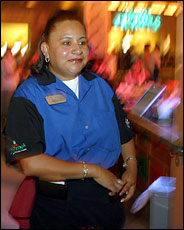
Steven Greenhouse reports on the success of HERE Local 226 in organizing a largely minority and immigrant culinary workforce and fighting in solidarity to seize middle class status:

In most other cities, these workers live near the poverty line. But thanks in large part to the Culinary, in Las Vegas these workers often own homes and have Rolls-Royce health coverage, a solid pension plan and three weeks of vacation a year. The Culinary’s extraordinary success at delivering for its 48,000 members beckons newcomers from far and wide. By many measures, the Culinary is the nation’s most successful union local; its membership has nearly tripled from 18,000 in the late 1980’s, even as the rest of the labor movement has shrunk. The Culinary is such a force that one in 10 people here is covered by its health plan, and more than 90 percent of the hotel workers on the Strip belong to the union. The union is also unusual because it is a rainbow coalition, 65 percent nonwhite and 70 percent female. It includes immigrants from Central America, refugees from the Balkan wars and blacks from the Deep South.

The Culinary’s success cannot be separated from the industry’s wealth. With the profits rolling in, the casinos have decided to be relatively magnanimous to their workers to ensure labor peace and a happy work force. “When you’re in the service business, the first contact our guests have is with the guest-room attendants or the food and beverage servers, and if that person’s unhappy, that comes across to the guests very quickly,” said J. Terrence Lanni, chairman of the MGM Mirage, which owns the MGM Grand, the world’s largest hotel, with 5,000 rooms and 8,200 employees. “These are people who are generally happy. Is it perfect? No. But it’s as good as I’ve seen anywhere.”

Under the Culinary’s master contract, waiters are guaranteed $10.14 an hour before tips, the highest rate in the nation. In Las Vegas, unionized hotel housekeepers generally earn $11.95 an hour, 50 percent more than in nonunion Reno. The Culinary contract guarantees workers 40 hours’ pay each week, meaning housekeepers earn at least $478 a week, while in other cities housekeepers often work 30 hours and earn just $240. The Culinary’s workers pay no premiums for health care, and they often pay just $10 for a dentist’s visit, while nonunion workers often pay upwards of $150. “Our wages are higher, the medical benefits are great, and we have a guaranteed 40-hour week,” said Marianne Singer, a waitress at the unionized MGM Grand. “Thanks to all that, I have a beautiful 2,000-square-foot home with a three-car garage.”

…”In Las Vegas, more so than any place in the country, the hospitality industry and the union have realized it is not mere rhetoric to say, ‘We’re all in this together,’ ” said John W. Wilhelm, president of the Culinary’s parent union, the Hotel Employees and Restaurant Employees International Union.

The article identifies some of the key strategies which will define twenty-first century unionism: Mobilizing resources for a tremendously threatening corporate campaign when necessary to pressure management, working cooperatively to marshall human and political resources when possible for goals shared with management, aggressively pursuing card-check neutrality, and most fundamentally, focusing on organizing and empowering formerly disenfranchised workers to achieve tangible results.

And in another article, Greenhouse profiles one of those workers:

Ms. Diaz arrived illegally, but she eventually obtained a green card and citizenship through her father, who had been granted amnesty. For years, he had worked at a carwash in Los Angeles. Today, her whole family – parents, two sisters and five brothers – lives in Los Angeles. Once in Las Vegas, Ms. Diaz took a series of nonunion housekeeping jobs that she did not love, at a Best Western hotel, at Binion’s Horseshoe Casino, and finally at the luxurious Venetian. “In the hotels, the hardest job is housekeeping,” Ms. Diaz said. “It’s really hard when you come, and you don’t know the language. You want to be somebody, but it’s very hard.”

Two years ago, Ms. Diaz learned from the wife of one of her husband’s co-workers that there were unionized restaurant openings at the Luxor. Weary of making hotel beds and cleaning bathrooms, she landed a job busing tables at La Salsa. It paid $9.24 an hour, plus about $4 an hour in tips. The health plan was so good that she paid no premiums and made only modest co-payments. But Ms. Diaz had greater ambitions. After she passed the Culinary Training Academy course, she was immediately promoted to waitress. Now she is responsible for a half-dozen tables in the ocher-colored restaurant, which has the music of a Mexican crooner piped in. She greets customers with her big smile and tentative English, often recommending her favorite dish, the fajita salad.

As her status at La Salsa has risen, so has her pay. Las Vegas’s unionized busboys and waiters make the same base salary – $10.14 an hour, the highest rate in the nation. (By comparison, most waiters in New York City make $3.30 an hour before tips.) But waiters make much more from tips than busboys, who must be content with the often-meager amounts that waiters share with them.