My Dad passes along an AP photo of army troops being addressed by George Bush in Kansas:
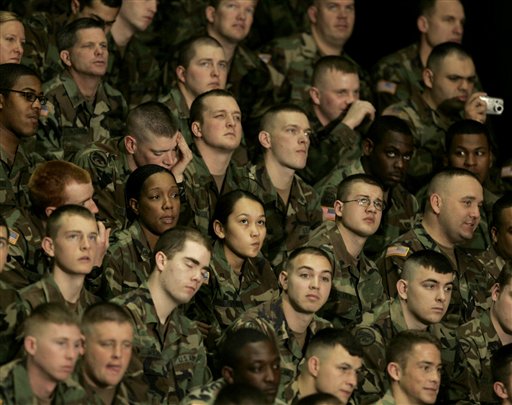
Doesn’t look like the President has much new to say…
My Dad passes along an AP photo of army troops being addressed by George Bush in Kansas:
Doesn’t look like the President has much new to say…
Big week on the not-trampling-over-all-of-our-values-and-freedoms-in-the-same-of-security front. I’m skeptical of how much difference the McCain ammendment committing us not to torture will make on the ground, but it’s a good sign that even after sending Dick Cheney out of his undisclosed location and onto Capitol Hill, Bush wasn’t able to keep Congressional Republicans on the reservation (the anti-anti-torture reservation, that is). The ultimate result, in which Bush met McCain much further than halfway from his original “waterboarding is freedom” position, shows him to be a weakened President and puts this nation back on record against willfully inflicting abusive pain on prisoners. The urgency of the issue, and the limitations of legal language like McCain’s in addressing it, are reinforced in Human Rights Watch’s announcement today on pervasive torture in secret US-operated foreign prisons:
Eight detainees now held at Guantánamo described to their attorneys how they were held at a facility near Kabul at various times between 2002 and 2004. The detainees, who called the facility the “dark prison” or “prison of darkness,” said they were chained to walls, deprived of food and drinking water, and kept in total darkness with loud rap, heavy metal music, or other sounds blared for weeks at a time. The detainees offer consistent accounts about the facility, saying that U.S. and Afghan guards were not in uniform and that U.S. interrogators did not wear military attire, which suggests that the prison may have been operated by personnel from the Central Intelligence Agency…Some detainees said they were shackled in a manner that made it impossible to lie down or sleep, with restraints that caused their hands and wrists to swell up or bruise. The detainees said they were deprived of food for days at a time, and given only filthy water to drink. The detainees also said that they were held incommunicado and never visited by representatives of the International Committee of the Red Cross or other independent officials.
This “dark prison” report follows Friday’s New York Times revelation that President Bush has been authorizing the NSA to spy on Americans without even going through the secret courts designed for the purpose, which should shake any confidence one might have that better laws will fully set this administration straight. Bush apparently believes that he is authorized to personally designate Americans as surveillance targets based on the congressional resolution authorizing him to go to war in Afghanistan.
That Congress showed much less deference on Friday, when Bill Frist could only muster 52 votes for cloture on the Conference Committee’s version of the PATRIOT Act reauthorization, which took out all the civil liberties protections that Russ Feingold and others managed to get into the version passed unanimously by the Senate. In a striking victory for sensible privacy protections over fear-mongering, Feingold, Leahy, and company have kept the Senate from approving the Conference Committee Draft. It’s also a huge victory for Feingold personally, who has gone from being the only Senator to vote against the PATRIOT Act to leading a charge to continue debate on the bill which saw more Republicans cross over to oppose cloture than Democrats crossing over to support it. Looks like the Democratic leadership, rather than marginalizing him, is now trying to pull him into the party establishment, handing him a seat on the Intelligence Commission.
Hillary Clinton, meanwhile, made the news for her own sorry contribution to the discourse on patriotism and freedom: a proposal to ban flag-burning. Hers is ostensibly a compromise position in that it’s a bill rather than a constitutional amendment, and it only applies on public property or when someone is intimidated. But legitimating speech restrictions based on how uncomfortable the speech makes other people feel makes a mockery of free speech. She should know better.

Bush today pardoned not one, but two turkeys. They’re both going to Disneyland.
Look who’s encouraging a culture of dependency now?
Hope the Cato Institute won’t go easy on this soft on turkey/ soft bigotry of low expectations shtick.
Otherwise, more turkeys might settle for sucking on the teat of the welfare state rather than claiming their piece of the ownership society.
Anyone wondering what passes for candor in the Bush White House could get a good sense from the documents released today about his relationship with then-Governor’s-Counsel Harriet Miers by the Texas State Library:
“You are the best governor ever – deserving of great respect,” Harriet E. Miers wrote to George W. Bush days after his 51st birthday in July 1997…Mr. Bush returned the admiration, the files show. After Ms. Miers’s birthday wishes, he wrote thanks and a “happy 52nd to you.” He added, “I appreciate your friendship and candor – never hold back your sage advice.”
Bush’s defense against charges from the right and the left that he’s out to fill a vacancy on the highest court in the land with a crony? Referencing the magazines that listed her as an uber-influential lawyer…based on her status as Bush crony. As Salon notes, this is just a circular argument:
…why did the National Law Journal consider Miers to be so “influential”? If the [National Law Journal] items posted at the pro-Miers site JusticeMiers.com are any indication, it wasn’t because she had a keen legal mind or some other qualification for the Supreme Court. It was, in large part, because she was so well connected, even then, to somebody named George W. Bush. Naming her to its 50 most influential women lawyers list in 1998, the NLJ said that Miers “is a big wheel in the big state of Texas, where she is chair of the Texas Lottery Commission and the personal attorney of Gov. George W. Bush.”…the NLJ named Miers to its 100 most influential lawyers list in 2000, it began by saying she was Bush’s personal attorney, that she had served as general counsel for Bush’s gubernatorial transition team, that she “handled background research, looking for possible red flags, during [the] early days of [Bush’s] 2000 presidential campaign,” and that Texas newspapers have suggested that she might be named attorney general or get some other “key administration post” if Bush were elected president.
That’s the fun thing about being President of the United States: You get to make whomever you want into someone influential, and then you get to give them wide-ranging power over the future of the country. That, and that chef who cooks whatever you want.

Steve Bell: “Do you think we’re going to be able to pass substantial Medicaid cuts and Social Security reform in the middle of this? You can’t put that much on the plate.”
Bill O’Reilly: “A lot of the people — a lot of the people who stayed wanted to do this destruction. They figured it out. And that’s — I’m not surprised.”
Rick Santorum:”There may be a need to look at tougher penalties on those who decide to ride it out and understand that there are consequences to not leaving.”
Grover Norquist: “I don’t think Republicans will be fooled into taking this necessary spending and using it to oppose pro-growth tax cuts.”
Barbara Bush: “And so many of the people in the arena here, you know, were underprivileged anyway, so this is working very well for them.”
George Bush: “Out of the rubbles of Trent Lott’s house–he’s lost his entire house,” cracked Bush, “there’s going to be a fantastic house. And I’m looking forward to sitting on the porch.”

In the wake of Russ Feingold’s call last week for a clearly-defined timetable for withdrawl of American troops from Iraq, President Bush has been stirring himself from his vacation long enough to offer a series of iterations of the same tired argument that announcing plans to withdraw troops would be letting the terrorists win (a category which, to review, includes smkoing pot, buying knock-off merchandise, and treating intelligence claims with skepticism, but doesn’t include buying an SUV, writing gay people out of the constitution, or renewing the PATRIOT Act). The latest edition of this argument, deployed for the liberal policy threat du jour, is dressed up in tactical sounding language about “emboldening” terrorists, but the thrust is nothing new: There are evil people who must be defied, and they want us to take troops out of Iraq, so we must do the opposite. Comforting rhetoric for some, but not much of a military strategy.
In Iraq, as elsewhere, there may be a certain number of fanatics willing to sacrifice anything under any circumstances, but there’s a much larger number of people who weigh their choices based on an array of perceptual, factual, emotional, and social, factors which drive one towards or against an act of terrirism. Bush would have us believe that an announcement of a schedule for American withdrawl would inspire more of these people to take Iraqi and foreign lives. This would require that there be a significant number of angry people not currently “emboldened” to take action because it seems futile, who on hearing that US troops would be leaving would decide that insurgents could make a dent after all and would suddenly become violent, targeting – according to Bush’s rhetoric – the very troops whose tenure in Iraq had just been announced to be temporary. The sad truth is that terrorists are indeed making a dent in Iraq, and they seem to be plenty emboldened. More credible, I’d say, is the opposite theory: the creation of a clear timetable for American withdrawl, with doing little to satiate insurgent leaders, would deprive them of their greatest recruiting tool and send a signal well beyond Iraq’s borders that the United States government does not have imperial ambitions in the country. As Feingold himself argued two months ago:
When I was in Baghdad in February, a senior coalition officer told me that he believes the U.S. could “take the wind out of the sails of the insurgents” by providing a clear, public plan and timeframe for the remaining U.S. mission. He thought this could rob them of their recruiting momentum. I also think it could rob them of some unity. All reports indicate that the forces fighting U.S. troops and attacking Iraqi police, soldiers, and civilians are a disparate bunch with different agendas, from embittered former regime elements to foreign fighters. The one thing that unites them is opposition to America’s presence in Iraq. Remove that factor, and we may see a more divided, less effective, more easily defeated insurgency.

If Roberts’ nomination was supposed to push perjury and the outing of an undercover agent off the front pages, it hasn’t been entirely successful. We now know that Ari Fleischer (don’t you miss him?) had the memo identifying Plame, that it was marked as secret information, and that he told the Grand Jury he never saw it. And we now know that Karl Rove and Scooter Libby are both under investigation for perjury over their own Grand Jury testimony. And now Time is casting further doubt on claims that Rove heard about Plame from media contacts and reporting one official’s account of “general discussion with the National Security Council and the White House and State Department and others” about Plame.” But they’re not the only ones failing to tell the truth under oath on an issue of urgent public concern. Turns out John Bolton falsely disclaimed having been interviewed about the original Niger forgeries which inspired Rove and company to smear Joe Wilson in the first place. Bolton’s truth problem, unsurprisingly, seems not to have given any pause to President Bush in his plan to bypass the Senate with a recess appointment.
As for Roberts himself, looks like he’s been less than upfront about his role in litigating Black Floridians’ votes out of existence in the name of equal protection. Same goes for his Federalist Society membership, which makes you wonder what other groups he doesn’t remember joining. And most troublingly, he may have told Dick Durbin that he would recuse himself from casting votes to uphold laws or rulings in accordance with the constitution and opposition to his faith, an especially eerie argument in light of his callous, anti-pluralistic advice that students who don’t feel comfortable with sectarian religious observance at their graduations just stay home.

While I don’t at all agree with Thomas Geoghegan’s contention in Which Side Are You On that the ACLU’s agenda, while noble, wouldn’t “cost anyone anything” to implement, he does speak to a well-justified frustration many “labor liberals” feel at the difficulty of stirring certain civil libertarians to get up in arms about the civil liberties of workers on and off the job. Not only are positive rights (like economic security) crucial to the meaningful exercise of negative rights (like free speech), positive and negative rights frequently and fundamentally intersect, perhaps nowhere moreso than the workplaces in which millons spend the majority of their waking hours. Opposition to civil liberties comes not only from those who see in others’ exercise of their rights a threat to their values but also from those who see in others’ exercise of their rights a threat to their economic interests. That’s why the right of workers to speak, assemble, and organize on and off the job has always been threatened in this country. And that’s why it’s so often fallen to unions, in Nathan Newman’s words, to “bring the first Amendment to the workplace.” It’s worth asking (as Geoghegan was trying, though through a troubling turn of phrase, to do) why the idea of deprivation of civil liberties affects many of us more viscerally than the idea of economic deprivation. But even those who only get up in arms over the former should be disturbed that, as Geoghegan has been reminding us for years, American law offers you no protection against being fired for expressing your political beliefs, and promises the weakest of responses to employers who threaten, punish, or fire workers seeking to bargain collectively.
What are the stakes? The Bush-appointed majority on the National Labor Relations Board provided a reminder last month when it upheld a security firm’s rule that bars its employees from “fraternizing” with each other on or off the job. Guardsmark insisted that its employees give up their right to associate with each other socially on their own time as a condition of employment, and the NLRB blessed the company to keep the rule in place.
TPMCafe’s guest stint by Thomas Frank (One Market Under God, by the way, is a masterpiece) has stirred a spirited debate about the place of populism in a progressive future. Populism is a word which has rightly come up fairly frequently in more- and less-enlightened discussions of the left’s future, but too often it seems like folks are talking past each other. Here are six of the somewhat but not entirely related themes I think are in play in the way different people discuss populism:
Progressive Economics: In broad strokes, the economic policy proposals that get labeled as populist are the ones least popular with the Washington Post editorial board and the “Washington Consensus” crowd: fair trade or no trade; downward economic redistribution; unionization. Opposition to immigration often gets grouped in here as well as part of the same package, though for obvious reasons I’d rather apply the populist label to the push for equal labor rights for immigrants.
Direct Democracy: The other set of policy proposals which usually get the populist labels are the ones which bring political decisions under more direct control of the American public. This includes taking decisions away from judges and handing them over to legislatures and taking them away from legislatures and handing them over to public referenda.
Trust in crowds: Populism is also used to describe a posture – whether held by politicians or activists – of trust in the mass public and distrust in elites. Usually, trust in the public is justified by an appeal to the wisdom of common people in identifying their own problems and synthesizing their own solutions. And distrust in elites is justified on the grounds of their inability to understand those insights or, more often, their narrow interests.
Democratic Legitimacy: Populism also describes a particular kind of appeal made by elected or unelected political leaders. Candidates for office, especially, tend to get the populist label for seizing democratic legitimacy for themselves – that is, for framing themselves as the bearers and protectors of the people’s will. The corollary to the candidate as representative of the masses is the candidate as enemy of the elites, whose hostility is easily explained by their opposition to the popular policies and popular mandate.
Prejudice: Populism is also a frequently-invoked label to describe all manner of ugly prejudice, be it directed against Blacks, Jews, homosexuals, or immigrants. In this conception, populism is the cry of some self-defined majority against unwelcome interlopers. This meaning of populism – which gives elites a lot of credit – is never far when someone’s looking to discredit one of the others.
Economic Focus: Maybe the simplest sense in which the word populism is used is to refer to a focus on economic issues (rather than a particular stance on them), to the exclusion of others.
That makes two kinds of policy approaches, two rhetorical/ philosophical postures, a question of focus, and a very bad thing (generally thrown into the mix by pundits like Joe Klein to make everything associated with the word sound ugly). Each of them, though, has a way of showing up implicitly in discussions about what is or should be populist.
What does it mean, for example, to ask whether Bill Clinton was a populist President? He often gets described that way, in large part because he ran on the economy (“It’s the Economy, Stupid”), and because his challenge to Bush benefited significantly from a sense that Clinton represented the concerns of the American people with which the President had fallen out of touch (and supermarket ray-guns). Others associate Clinton with the decline of populism in the Democratic party, and of the party in the country, pointing to his conservative stance on issues like NAFTA and the technocratic underpinnings of the “Reinventing Government” concept. I’m not going to say they’re both right (I’d say Clinton campaigned as a populist, but he didn’t govern as much of one). I will say that on those terms, it’s no surprise that those conversations don’t get farther than they do.
Thoughts?
Just watched Tucker Carlson on his new show complaining about the disparity between full-throated defenses of Roe from Democrats and opaque evasions from Republicans. He claimed to be at a loss as to why, with a nomination battle brewing, the Senators on his side are so hesitant to explicitly defend their desire to see Roe go. Hard to blame Tucker for wanting GOP Senators to talk more about how they really feel about the right to choose. There’s an obvious answer for Republicans’ behavior on this though: They know that most people disagree with them.
Amid all the judicial tyranny chatter, it’s easy to forget that between half and two thirds of Americans consistently tell pollsters that they want Roe upheld (the number is higher among moderates). A good number of them, unfortunately, are comfortable with restrictions on the right to choose which make it difficult for poor women or young women to exercise. (William Saletan documents this dynamic in Bearing Right, and makes a persuasive argument that the anti-government, family-centered rhetoric the pro-choice movement has used effectively to build support for Roe has backfired when it comes to laws which narrow whom it meaningfully applies to). That’s why the way Bush called for Roe to be overturned during the debates was with a coded reference to pretty universally unpopular Dred Scott.
News is that the Supreme Court nominee will be announced tonight at 9 PM, and the buzz is that it’s Edith Brown Clement. She seems like a likely choice: she’s a woman, has avoided drawing as much controversy to herself as a Janice Rogers Brown, and has a far right-wing vision for the court and this country (it always seemed to me that the Gonzales trial balloon was just about getting credit from Latinos for considering him and getting credit from evangelicals for not nominating him).
Brown Clement’s opaque views on abortion will likely continue to dominate news coverage; apparently she refers to Roe as “settled” but not made particularly clear whether she would be interested in unsettling it. The bad news there is, anti-choice leader Hadley Arkes is optimistic:
Just whether or when Roe v. Wade is actually, explicitly overturned may cease to matter quite as much. For in the meantime, the public would have the chance to get used to a continuing train of laws restricting and regulating abortion.
As for the Lochner litmus test, however Brown Clement feels about judicial activism to protect privacy, she seems all-too comfortable with judicial activism to strike down progressive regulations. As Nathan observes, she supported a challenge to the constitutionality of the Endangered Species Act, denied ADA protection to employees discriminated against for having HIV, and argued for making it harder for the poor to get legal representation by cutting legal fees when clients win small awards. As Jeffrey Rosen wrote last year:
How would a stealth candidate like Clement perform on the Supreme Court? Everything about her record suggests she would enthusiastically support the federalism revolution…Taken to its logical limits, the Constitution in Exile would call into question not only environmental protections but workplace regulations like the Occupational Safety and Health Act.

Scott McClellan, October 6, 2003: “The topic came up, and I said that if anyone in this administration was responsible for the leaking of classified information, they would no longer work in this administration.”
George W. Bush a few minutes ago, on whether that policy still stands: “If someone committed a crime, that person will not be in my administration.”
And here we thought it was liberals who went around “moving goalposts” and “defining deviancy down,” and George Bush who would bring us a “responsibility era.” Based on Ken Mehlman’s praise of Fitzgerald in his performances in front of the press yesterday (“Hey look! ‘Vindicate’ rhymes with ‘implicate’ – but it means the opposite!”), the Republicans seem to be betting that Fitzgerald won’t be able to prove Rove and company guilty, and that the spin-masters will be able to convince us that that means no one did anything wrong.
Just remember: Bush was for responsibility before he was against it.
 Josh Eidelson