I joined Doug Henwood’s Left Business Observer podcast to talk about why Walmart strikes happened, and how they could make a difference. Hear us here..
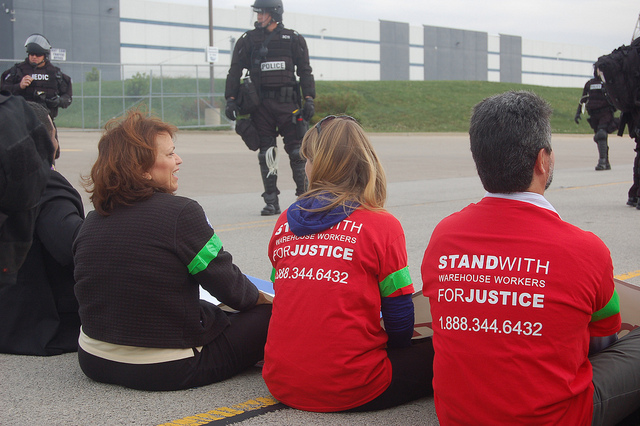
I joined Doug Henwood’s Left Business Observer podcast to talk about why Walmart strikes happened, and how they could make a difference. Hear us here..
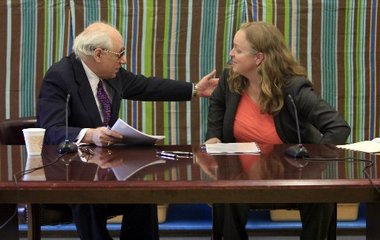
NEWARK—Six days after the city’s schools superintendent and teachers’ union president announced a tentative contract agreement, a group of union members gathered Wednesday night to discuss how to derail the deal.
The agreement, whose core compromise institutes performance-pay bonuses and peer evaluations, won praise from both New Jersey Republican Governor Chris Christie and American Federation of Teachers President Randi Weingarten. But members of Newark Education Workers (NEW) Caucus, a Chicago-inspired social justice group within the Newark Teachers Union (NTU), hope that on Monday, their co-workers will vote it down.

I was on The Ed Schultz radio show Monday to discuss workplace political coercion with guest host Mike Papantonio. You can hear it here..

I was on Ring of Fire with Sam Seder, discussing my feature in The Nation on Working America, and my Salon reporting on the Walmart strike wave. Here’s the audio.

I was on The Big Picture with Thom Hartmann, talking about what could unfold over the next month as Walmart workers build for Black Friday.
Sam Seder had me on Majority Report to discuss my reporting on the Walmart strikes. Here’s the audio.
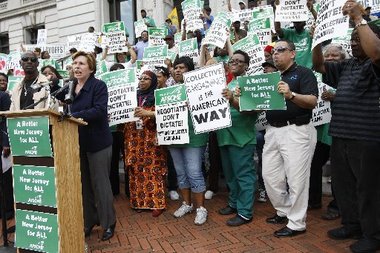
NEWARK, N.J.—At a Thursday press conference, the president of the city teachers union and the superintendent of schools signed a tentative agreement on a path-breaking new contract. Both sides touted the deal’s key compromise: The district will begin to peg teachers’ pay in part to evaluations, but teachers will have a role in evaluating each other.
The agreement has the blessing of New Jersey Governor Chris Christie and of national American Federation of Teachers President Randi Weingarten, who calls its provisions “a system of the future.”
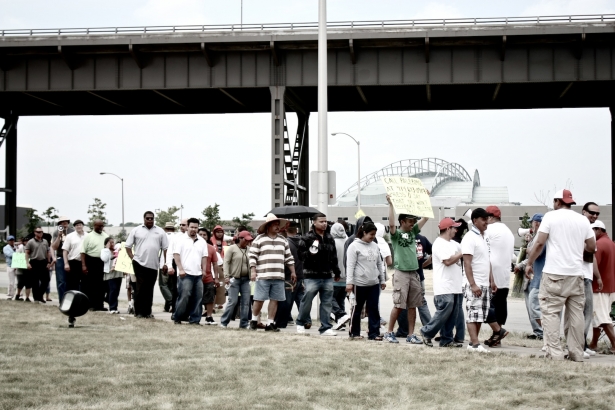
Four months into a bitter strike, labor groups are asking whether Palermo’s Pizza deserves its millions in public subsidies.
In a report released Tuesday and a legislative hearing Wednesday, strikers and their supporters charged that the non-union Milwaukee company isn’t offering the kind of good jobs that government funds and tax breaks are designed to encourage. The critiques, and an upcoming cross-country worker tour, represent the latest signs that advocates aren’t counting on labor law alone to punish Palermo’s mass firing of striking immigrants in May.
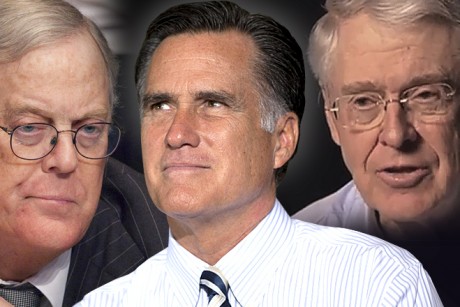
This week brought the second of two exposés that illustrate the twisted state of American labor law, which seemingly permits managers to urge and cajole their employees to donate to and even vote for their favored candidates, and workers to be fired for their political views, even if they express them only outside of work.
On Sunday, Mike Elk of In These Times revealed a political packet mailed to the 45,000 employees of a Koch Industries’ subsidiary, the Atlanta-based Georgia Pacific. The packet included a list of Koch-endorsed candidates and warned that electing the wrong people could be ruinous to the economy. The company also requires that workers get permission before running for office or joining the boards of nonprofits. One worker told Elk that a supervisor told him he wouldn’t get a promotion because he was “too political.” A local union official told Elk that he was getting calls from Georgia Pacific employees who were afraid they’d be fired for appearing in a photo with a local Democratic state Senate candidate outside their union hall, because the plant where they worked was visible in the backdrop.
In this week’s issue of The Nation:
One September night in the western Pennsylvania borough of Monaca, a disillusioned resident told a labor canvasser that he’d once “backed all of the Democrats all the way through,” only to realize “both sides” were “really full of shit.” Then he said something I heard often during my week in the region: “If all these factories were still running here, we’d all still have jobs.”
In the mostly white, once unionized, postindustrial towns around Pittsburgh, outsourcing casts a long shadow over undecided or uninspired voters. As Working America, an AFL-CIO affiliate for nonunion employees, tries to mobilize working-class voters for the election and beyond, offshored jobs are the ever-present context. They underlie the strongest indictments of both presidential candidates, and they’ve shaped something else: a sense that the past outstrips the future. People in this depressed region feel there’s a disconnect between the debates in Washington, DC, and the steady decline in Washington, Pennsylvania. “I’m not voting anymore,” one woman told a canvasser. “I’m done.” Her husband added, “Get the fuck off my porch.”
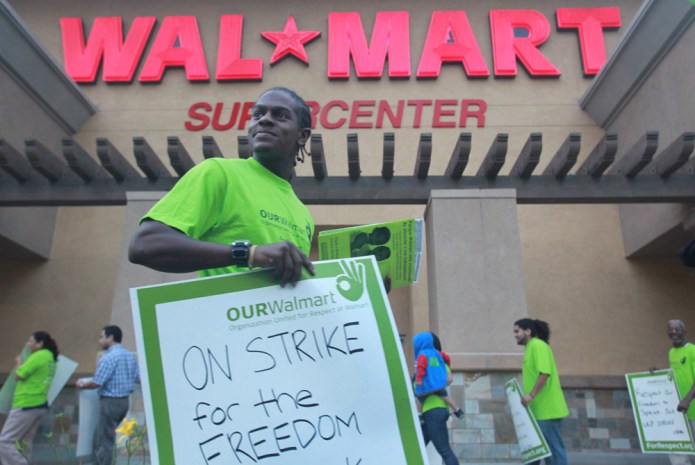
I was back on The Union Edge radio to discuss my reporting on the Walmart strikes. Here’s the audio.
Fairness and Accuracy in Reporting (FAIR) invited me to their Counterspin radio show to discuss the Walmart strikes and their media coverage. Here’s the audio.
 Josh Eidelson