Matthew Filipowicz had me on his show to discuss my Alternet piece on Mitch Daniels, “Right to Work” and the modern GOP. Stream or download it here.
Matthew Filipowicz had me on his show to discuss my Alternet piece on Mitch Daniels, “Right to Work” and the modern GOP. Stream or download it here.

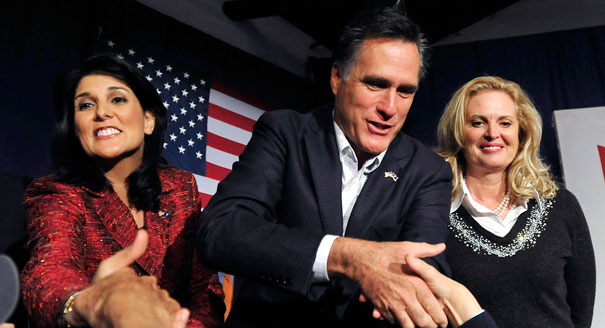
As Mitt Romney campaigns in today’s Florida presidential primary, airline workers have been following him with a message about one of his old company’s newest clients: Airline giant AMR, the parent company of American Airlines and American Eagle. AMR, which filed for bankruptcy in November, last week announced plans to retain the advice of Bain & Co., the consulting firm where Romney worked before co-founding private equity firm Bain Capital in 1985. “He’s talking about creating jobs,” says Transport Workers Union President James Little, but “he’s not a job creator. He’s a job cremator.” TWU represents 24,000 members at American Airlines and American Eagle whose jobs and benefits are threatened in the bankruptcy process.

Last night’s State of the Union response by Mitch Daniels was remarkable before he uttered a single word. Daniels’ response was the first to be delivered from a building surrounded by dozens of police cars and chanting activists, by a man on the cusp of delivering a body blow to workers’ rights. “We were surprised, frankly,” says Jeff Harris of the Indiana AFL-CIO, “that the Republicans would choose somebody who is in open war with his constituents and his citizens and put him up as the national speaker for the Republican Party.” For anyone who thought that progressive victories in Wisconsin and Ohio would lead the national Republican party to tone down the union-bashing, last night was a rude awakening.

“I’m sick of the union taking so much of my money out of every paycheck,” Frank tells his co-worker Bob. “I don’t know why you voted them in.” “Don’t look at me,” Bob responds. “I never even got a vote.” Bob then polls fellow auto repair shop employees, and they all say they got hired long after the union election. “Only 10 percent of people in unions today actually voted to join a union,” declares a narrator. “Everyone deserves a vote at least one time.”
As this TV ad ends, a worker chides the one remaining employee who might have voted in the union: an old man whom we see fumbling with his equipment.
At Alternet:
On the South Carolina campaign trail Tuesday, a questioner at a Chamber of Commerce forum asked Rick Perry what the National Labor Relations Board would look like if he were President. For today’s GOP, that’s the equivalent of a slow pitch over home plate, and Perry knocked it out of the park: “There wouldn’t be one.” As Slate reported, “The crowd lit up at that.” Perry’s headed back to Texas, having dropped out just days before the primary. But NLRB-hatred is still going strong.
Three months into a bitter strike, the Graduate Students Organizing Committee sent an e-mail to supporters. “Like their refusal to bargain, their threats last fall, and the docking of prospective pay for striking,” the union wrote, “John Sexton and the NYU administration, aided by former Clintonites Jacob Lew and Cheryl Mills, are again hiding behind a right-wing, Republican NLRB.”
Six years, later, Lew and Mills are back in Washington. Mills is Hillary Clinton’s Chief of Staff at the State Department. Lew reprised his Clinton Administration role as director of the Office of Management and Budget—until last week, when Obama promoted him to White House Chief of Staff.
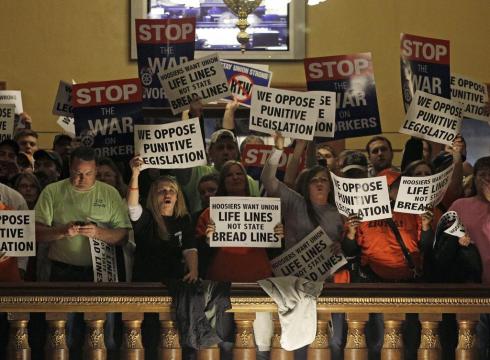
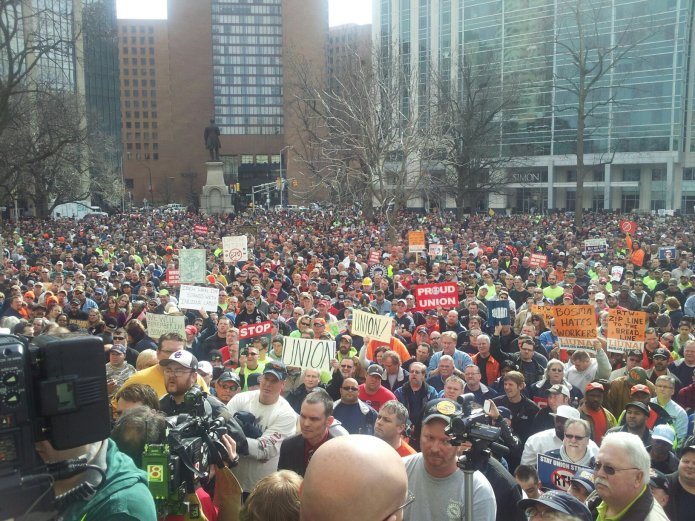
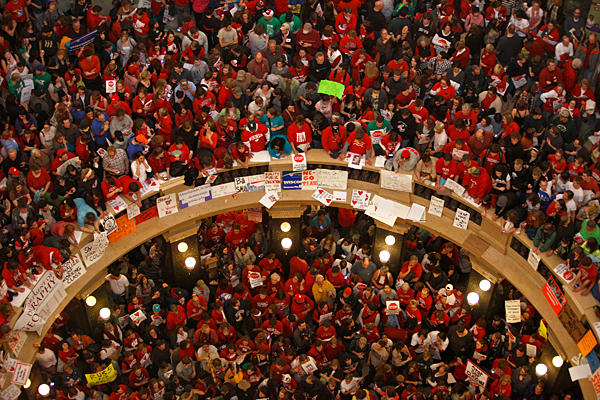
One year ago, a broad coalition of Wisconsinites held a massive three-week occupation of their state capitol opposing Governor Scott Walker’s bid to cripple collective bargaining for public employees. The Wisconsin uprising captured national attention, inspired organizing across the country, and instigated recall campaigns of its most prominent opponents. Now, another Republican legislature is set on breaking labor’s back, and union activists in the Hoosier State are hoping for an uprising of their own against. Governor Mitch Daniels’s efforts to make Indiana the first “right to work” state in the industrial Midwest.
In the current issue of Yes! magazine, I have a review of the new book We Are Wisconsin:
Six months after Madison was occupied by students, teachers, and work- ing people opposed to their governor’s anti-union bill, “Wisconsin” remains not just the name of a state, but shorthand for a movement. It was a mass uprising that developed by the hour—sometimes faster. People knit together in defiance of threatened arrest. Pizzas arrived that had been ordered by supporters in Europe. Activists organized cleaning crews. Cops finished their shift policing the capitol and joined other workers to occupy it.
Five days before today’s presidential primary, the New Hampshire State House passed a “Right to Work” bill for a second time. The bill now heads to the State Senate, and is likely to land on the desk of Democratic Governor John Lynch. In November, State House Republicans came within twelve votes – out of 400 legislators – of overriding Lynch’s veto of a prior such bill.
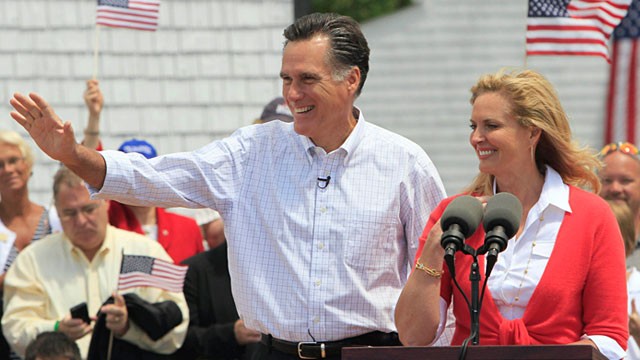
Republican presidential candidates egged on their New Hampshire counterparts in both debates held this weekend in the “first in the nation” primary state. “Right To Work legislation makes a lot of sense for New Hampshire and for the nation,” said front-runner Mitt Romney in Sunday’s debate on Meet the Press. Romney’s call for a federal “Right to Work” law was joined by his opponents, including Rick Santorum, who has drawn fire for opposing such a law while in the U.S. Senate. Asked if they saw any positive role for unions, Romney mentioned job training, and Santorum mentioned organizing community service activities “like a business does”—neither of which involves conflict with management.
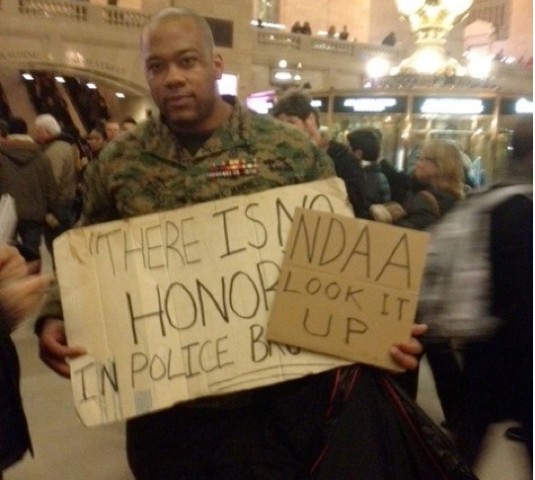
Five hundred people returned to Zuccotti Park on New Year’s Eve, with drums, chants of “Whose Year? Our Year!”, and a tent, which they say they gave to police in exchange for entrance to the park. An hour before midnight, police and occupiers attempting to remove metal barricades around Zuccotti had a violent confrontation and, by 1:30 a.m., police had cleared activists from the park.
In the “Noted” section of this week’s The Nation, my take on the NLRB’s rules change:
On December 21 the National Labor Relations Board (NLRB) finally passed a rule change that will reduce delays for workers seeking unionization. As University of Oregon professor Gordon Lafer recently wrote in these pages [“A Change Unions Need,” October 10], the proposed changes were modest but would still “make workplace elections more democratic.” That was before the board’s Democratic appointees, acting to allay objections from GOP member Brian Hayes, further watered down the reform.
Subscribers can read it here.
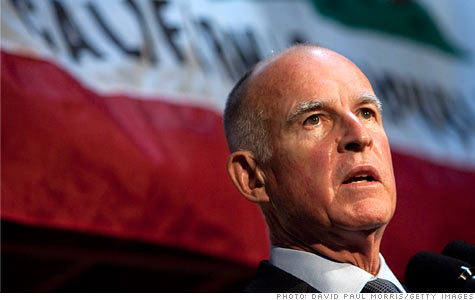
California voters can expect competing tax hike measures on November’s ballot—and competing campaigns from major unions. Last month, Governor Jerry Brown announced a campaign for a ballot measure that would impose a five-year tax increase on incomes above $250,000, paired with an across-the-board sales tax increase. That proposal has siphoned attention, and supporters, away from a months-old alternative: the campaign for a permanent tax hike on income over $1 million.

 Josh Eidelson