BLOGGINGHEADS WITH DORIAN WARREN

Dorian Warren and I recorded this chat for the Roosevelt Institute’s Bloggingheads channel, Fireside Chats. We discussed the attacks on labor in the states, the relationship between law and organizing, and democracy in the workplace. You can stream or download the video or audio here.

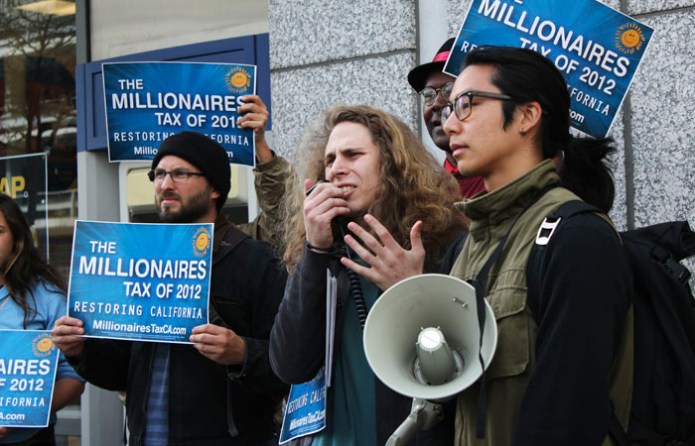
MILLIONAIRE’S TAX BACKERS COMPROMISE WITH CALIFORNIA GOVERNOR

At In These Times:

On Wednesday, an advisor to Jerry Brown announced the suspension of signature-gathering on a tax referendum California’s governor had previously pushed for the November ballot. Brown’s move follows a deal reached last month with backers of a more progressive alternative, the “Millionaire’s Tax.” Unions that spent months backing two competing referenda have now coalesced behind a compromise—though not everyone from the old Millionaire’s Tax coalition is on board.

Check it out.

WISCONSIN UNION DIVIDED OVER WALKER RECALL ROLE

At Salon:

Unions in Wisconsin made history by mobilizing the recall against Gov. Scott Walker, but it’s too soon to say whether the state will follow through and kick him to the curb. One thing that could work in his favor: The inability of some of the state’s powerful unions to consolidate behind a Democratic candidate to oppose him. Having come this far, some labor activists now question whether the best way to flex their muscle is to sit out the election altogether.

This is the drama unfolding at the Teaching Assistants Association, which represents graduate students and project assistants from the University of Wisconsin-Madison. No union is more identified with the anti-Walker mobilization. Days after he introduced his bill to gut collective bargaining, TAA members showed up at the state capitol, sleeping bags in hand, and kicked off what became a 16-day occupation. That emboldened Democratic senators to flee the state to deny Walker a quorum – bringing national media attention to the controversy.

Now a month before the May 8 primary, two Democrats, former Dane County Executive Kathleen Falk and Milwaukee Mayor Tom Barrett, are neck-and-neck at the front of the pack. And TAA members are split on what to do about it.

Here’s the rest.

THE EMPLOYER STRIKES BACK

At The American Prospect:

Becki Jacobson, 48, has worked as a process technician at American Crystal Sugar Company in Minnesota since she was 18. Eight months ago, she showed up for work, but the company refused to let her start her shift.

Like 1,300 other members of the Bakery, Confectionery, Tobacco & Grain Millers union (BCTGM) at American Crystal Sugar, Jacobson wasn’t fired. She was locked out. Crystal Sugar is wielding a powerful weapon against its workers: Its right to deny them work for refusing a worse contract after their existing one expired. Jacobson and her co-workers are left with a choice. They can hold out while non-union workers do their jobs, make huge concessions, or dissolve the union.

Check it out.

AMERICAN AIRLINES PETITIONS TO OVERRIDE UNION CONTRACTS

At In These Times:

Four months after filing for bankruptcy, last week American Airlines’ parent company AMR petitioned a judge to override its union contracts. In a letter to employees, American CEO Thomas Horton said that “with losses mounting and oil prices rising, there is growing urgency to move more quickly.” Horton wrote that “consensually negotiated contracts…will remain the ultimate objective” in union negotiations. But he warned that “failure to make the right changes is failure and that puts all jobs at American at risk.”

Here’s the rest.

GARBAGE COMPANY’S TRASHED PROMISE SPARKS RARE ROLLING SYMPATHY STRIKE

At Alternet:

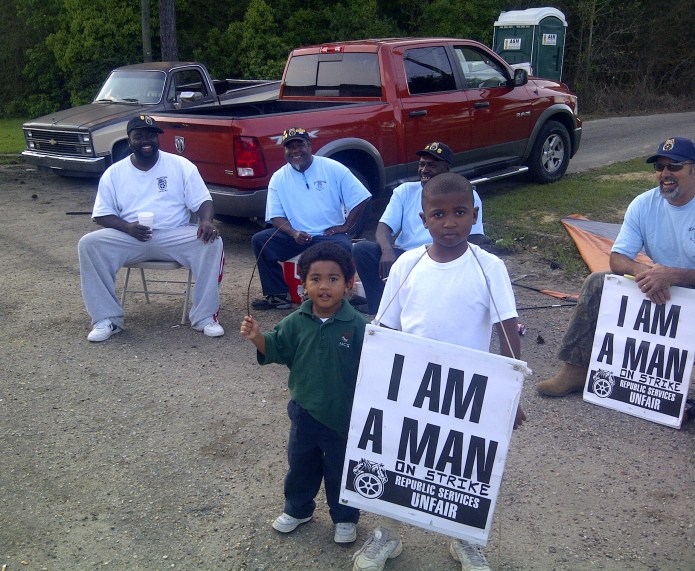
Thursday, 250 Teamsters in Seattle went on strike against Republic Services, the second-largest waste disposal company in the United States. Workers in Buffalo, New York, and Columbus, Ohio struck Republic for three days earlier this week. These workers aren’t responding to moves by local management. Instead, they went on strike in solidarity with 24 striking co-workers in Alabama. That kind of strike has become all too rare in the modern labor movement – and it’s usually illegal.

Check it out.

TEAM ROMNEY’S ALLEGED LABOR MOLE

At Salon:

On Sept. 2, the National Review posted on its website an Op-Ed blasting a new rule requiring companies to inform employees of their union rights. The article condemned the rule as “an unwarranted usurpation” and “regulatory sorcery” that “diminishes” the National Labor Relations Board. None of this was particularly interesting or surprising, given the conservative politics of the National Review and the article’s author, Peter Schaumber, a former NLRB chairman who’s now advising Mitt Romney’s presidential campaign.

More scintillating than the article itself is the story of its genesis, which was laid out in a report from the NLRB inspector general this week. According to the report, it appears the article was edited by current NLRB member Terence Flynn, who served as chief counsel to Schaumber when he sat on the board. The Op-Ed “appears to be a further revised version” of a file found on Flynn’s government-issued computer, complete with tracked-changes edits marked as Flynn’s. And the IG says Flynn wasn’t just providing Schaumber with freelance editing: he is also accused of violating ethics rules by leaking to Schaumber and other conservatives internal info from the agency they were out to obstruct.

Check it out.

GRAD STUDENT WORKERS PLAN COUNTERATTACK

At In These Times:

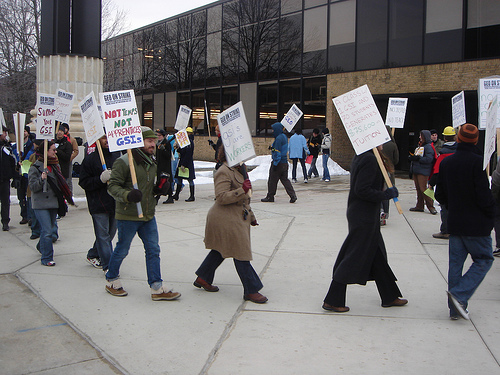
Following two years of organizing and months of hearings, this month Michigan’s state labor board was set to rule on whether to reverse a 1981 decision that stripped union recognition from the state university’s graduate student research assistants (GSRAs). That ruling never happened. Instead Michigan’s House and Senate passed a bill declaring GSRAs ineligible for union recognition, and Governor Rick Snyder signed it into law on March 13.

Here’s the rest.

SURPRISING NEW ALLIANCE BETWEEN THE TEA PARTY AND LABOR

At Salon:

When Republicans rode Tea Party anger to large majorities in Georgia’s state Legislature in 2010, it seemed inevitable that sooner or later some of these restive constituents would turn against them. Few, though, would have predicted the cause of an uprising that went down this week: an anti-picketing bill aimed at silencing union members.

Check it out.