3 BIG LIES AT THE HEART OF REPUBLICAN ATTACKS ON THE POST OFFICE


I have a new piece up at Alternet on what the attack on the Postal Service shows us about what the GOP House really cares about:

Now, like the US economy, the USPS faces a crisis brought on by Republican policies, which Republicans insist only more right-wing policies can solve. USPS has informed Congress that it can’t pay $5.5 billion due to a federal retiree health fund September 30, raising prospects of default. Republicans, led by Rep. Darrell Issa, are demanding layoffs and service cuts. Here’s how the Republican plan – burning the Postal Service to save it – contradicts the stories Republicans tell us about themselves.

LITTLE LOVE FOR LABOR


Here’s my post on The Nation‘s site about how history textbooks distort and obscure labor history:

Taken together, such portrayals make it easy to come away with the sense that unions were an understandable response to sweatshop conditions in the past, but have been rendered unnecessary, and even counterproductive, given contemporary legal regulations and a more enlightened business class. Not coincidentally, that’s the impression you’d get from a lot of our newspapers, politicians, and TV shows too. Meanwhile, Walgreens fires an 18-year worker for grabbing a bag of chips to ward off a diabetic attack.

Check it out.

FIRED FOR BACKING A UNION


Through IPS’ Other Words project, I have an op-ed up at the Columbia Missourian and other local sites:

It would be nice to say that what happened to Green is unusual or that going to the government means she’ll get justice. But the truth is that companies fire workers for union activity all the time, and they often get away with it.

Check it out.

THE FALL NLRB SEASON


My latest Prospect piece explains why this fall could be the last opportunity for pro-labor NLRB decisions for a long time, and suggests what some significant ones could be:

Over the past months, the GOP has escalated attacks on the NLRB as a rogue job-killing agency, and Republicans’ willingness to use procedural tactics to block even recess appointments further raises the likelihood that once the pro-labor majority reaches its January expiration date, the board could be left to languish until the next presidential election. Although President Barack Obama inherited an NLRB with three vacancies, it took 14 months for him to fill any of them, due to a familiar combination of Republican obstruction and Democratic hesitance. Since then, “they’ve been playing defense,” says law professor and former NLRB attorney Jeff Hirsch, “and I don’t fault the board for that because they haven’t had a lot of time.” Come January, “I would be stunned if they actually get a third member on,” he adds. AFL-CIO President Richard Trumka says Republicans are trying “everything they can to prevent the NLRB from actually doing what it’s intended to do.”

Check it out.

CITIZEN RADIO INTERVIEW: FEAR BOEING, NOT BISEXUALITY

I had a blast recording this interview with the incredible Allison Kilkenny (@allisonkilkenny) and Jamie Kilstein (@jamiekilstein) of Citizen Radio. We talked about my Prospect piece on coming out as bisexual and my Dollars & Sense piece on why Boeing workers keep striking.

The episode also includes characteristically incisive and hilarious takes from Jamie and Alison on NYPD infiltrations and capes.

THE STRIKES THAT MADE BOEING A NATIONAL FLASHPOINT


My feature in next month’s Dollars & Sense labor issue is on news stands this week and online now:

So whatever the result, the Boeing case is less a story about the potency of current labor law than about the power of the strike on the one hand and the threat of retaliation on the other. It’s the story of workers who have refused to believe that they should cede a hard-won package of middle-class wages and workplace protections in the face of a major company’s multi-year effort to persuade or intimidate them into backing down. Now, after decades during which Puget Sound has been the only place Boeing assembles commercial aircraft, workers are right to recognize that the power to move work elsewhere has become a powerful weapon in management’s arsenal.

It was frustrating this summer seeing half the coverage of the Boeing NLRB complaint fail to mention retaliation for striking, and none of it address why Boeing workers have chosen to go on strike five times in three decades. So I went to Puget Sound to hear from veterans of the Boeing strikes. Check out the piece. And if you’re looking for a response to the claims of GOP politicians (echoed last week by NYT columnist Joe Nocera) about the case, here’s something I wrote in May.

AMBISEXTROUS


Here’s a piece I did for The Prospect sharing my experience coming out as bisexual six years ago:

One such study, released in 2005, came out a few months before I did. The New York Times headline blared, “Gay, Straight, or Lying?” I hadn’t told the person who showed me the article—or anyone else, for that matter—that I was wrestling with my own sexuality. I had promised myself that I would use my last year of college to figure out what my deal was. Seeing that article reinforced a fear that, however dishonest it may have been to portray myself as a gay-friendly straight guy, there was nothing I could say about my identity that would be both honest and perceived as such.

The piece discusses how suspicion of bisexuality is hurting the LGBT community. Check it out.

CREDO MOBILE, WARREN BUFFETT, AND THE LIMITS OF PROGRESSIVE BUSINESS


Continuing this week’s theme of telecom union density, I have a piece at Dissent on what Warren Buffett and CREDO mobile both showed us last week:

Two web petitions showed up in progressive inboxes last week. One, organized by Daily Kos in support of striking Verizon workers, was blasted out by “alternative” cell service provider CREDO Mobile. The second, organized by MoveOn, was a call for taxing the rich, piggybacking on a recent op-ed by billionaire Warren Buffett. Though neither petition itself is objectionable, together they illustrate a harsh reality: It’s easier to get the wealthy to share their money than their power.

Check it out.
Update: Good points (via facebook) from Jacob Remes:
Continue reading

STRIKE, INTERRUPTED


Here’s my take, at the Prospect, on the end of the Verizon strike and the challenge of reversing the decline in the company’s union density:

Early describes the regular reports he heard from Verizon Wireless workers of the ways management fostered resentment of their unionized landline counterparts. “You are the profit center,” managers would tell them. “You are the ones that are making us the success that we are today. See that guy over there, in that hard hat—do you know how much he makes?”

Check it out.

STRUCK OUT


I have a piece up at the Prospect interviewing Joe Burns on his book Reviving the Strike, which argues that the decline in strikes is a cause, not a consequence of the decline of the American labor movement:

Is the strike sick?

Strikes today are not very effective. The reason is that over the last 75 years, employers have been effective at pressing courts and Congress to outlaw effective strike tactics.

Check it out.

LONGSHORE WORKERS SOLIDARITY STRIKE SETTLEMENT RAISES QUESTIONS FOR FUTURE UNION ACTIONS

At Alternet, I break the news of a settlement between PMA and ILWU Local 10 over the latter’s industrial solidarity action – and describe the controversy that settlement has created among the membership:

Four months ago, longshore workers shut down the ports of San Francisco and Oakland in solidarity with workers in Wisconsin and across the country whose collective bargaining rights have come under attack. The Pacific Maritime Association (PMA), which is made up of longshore employers, responded with a federal court lawsuit against the workers’ union, International Longshore and Warehouse Workers Union (ILWU) Local 10. In an interview yesterday, Local 10’s president publicly acknowledged for the first time that PMA and Local 10 have agreed to a settlement. Workers will be discussing it at a membership meeting tonight – and some will be questioning whether the union gave away too much, and why they didn’t get to vote on it.

Check it out. And here’s my May story on the lawsuit for In These Times.

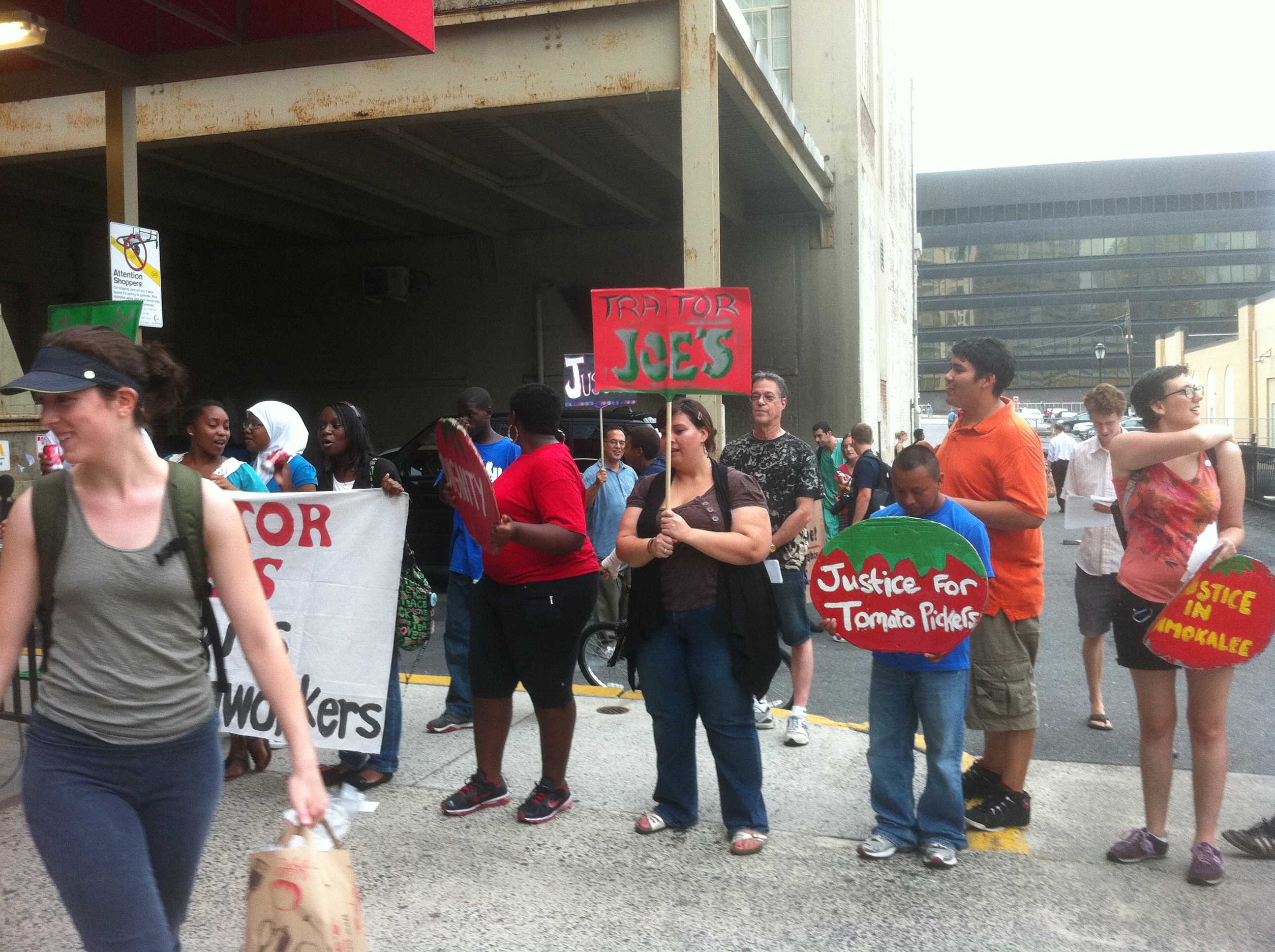
WHY WON’T TRADER JOE’S SIGN AN AGREEMENT NOT TO SELL SLAVE LABOR TOMATOES?


At Alternet, I report on the Coalition of Immokalee Workers’ campaign for a Fair Food Agreement with Trader Joe’s, and the company’s resistance – which I suspect is more about power than money:

The company’s letter passes responsibility onto its wholesalers, who buy tomatoes from growers and sell them to Trader Joe’s (and have less to fear from public embarrassment). In a point-by-point rebuttal to the letter, CIW retorts that “Apparently, Trader Joe’s is better at innuendo than math.” CIW notes that when it began discussions with the wholesalers — several separate competing companies — the wholesalers said they needed to talk to Trader Joe’s before moving forward, but then stopped returning CIW’s calls.

My piece also shares reports from tomato growers who’ve worked in Florida’s fields before and after their employers entered Fair Food agreements. Check it out.