My first YDN column of the year is on-line here.
I can’t promise that the writing’s as sparkling as Jack Abramoff’s Torah commentary.
My first YDN column of the year is on-line here.
I can’t promise that the writing’s as sparkling as Jack Abramoff’s Torah commentary.
Nathan Newman: “So subtract the Supreme Court and democratic reapportionment of the states might never have happened. And the anti-democratic rightwing recognized this and was prepared to make almost any deal to override the Supreme Court through a Constitutional Amendment, including cutting a deal with the labor movement.”
Robert Gordon: “The argument that he was just saying whatever it was convenient for him to say in order to get a job doesn’t sound too good coming from somebody who is now trying to get another job. There is something really slippery, or at least less than forthright, about his approach to his own record of actions and opinions.”
The Nation: “When in 1969-70 President Nixon nominated and lost both Clement Haynsworth and Harrold Carswell, the result was not “someone worse” but the pragmatic, humane Judge Harry Blackmun, who later wrote Roe v. Wade; when Bork was Borked, his replacement was Anthony Kennedy, who in 1992 joined fellow Reagan nominee O’Connor to reaffirm Roe.”
Twelve miners died after the Sago Mine explosion in West Virginia, and a thirteenth is in critical condition. That much has been all over the news this week. What hasn’t been, as Jordan Barab reminds us, is the mine’s 200 citations by the Mine Safety and Health Administration in the year leading up to this horrific but preventable accident. That includes 21 citations for “accumulation of combustible materials,” the likely fuel source for this kind of tragedy. The Sago mine had three times the industry average for accidents. The highest of the penalties for these citations? A $878 fine. But as Jordan notes, most of the penalties were closer to $60.
The human tragedy in West Virginia might give pause to some of the ardent libertarians committed to arguing that miners willfully and knowingly take risks upon themselves by entering into free contract arrangements, and that the industry which employs them will correct itself for the sake of free-market competition for employees. But not Glenn Reynolds. Why consider the perverse incentives that led to twelve men’s deaths when you can instead blame the media for passing along rumors that they hadn’t died?
The miners’ families aren’t in anguish because of false reports that these men were alive. They’re in anguish because these men are dead.

The good folks at Yale Alumni for Social Justice have kindly posted a paper I wrote sophomore year about the organizing campaign through Yale clerical workers won union representation twenty years ago and the strike which achieved their first first contract. It explores how they won and what implications it has for some of the prevalent theories about gender and union organizing. If you’re interested, check it out, and if you’ve written an article or paper about social justice struggles at Yale, send it to them.
Jack Abramoff pleaded guilty today to charges of conspiracy, fraud, and tax evasion under a plea bargain which limits him to ten years in prison. TPM and TPMCafe are Abramoff central today – check out the insight and speculation over there. As Josh observes:
This seems more like the beginning of a long process. They go after Ney first and continue their investigation, with Abramoff’s fate hanging in the balance, depending on how cooperative he chooses to be in providing information on coconspirators and sundry bad acts.
Abramoff is a bad, bad man (more on this from me here, here, and here) who did bad things not – as talking heads will tell you tomorrow – out of simple personal greed but as a devoted cog in a fundamentally corrupt corporate-GOP alliance which continues to wreak havoc on the country. So taking away his toys and using his testimony to go after his proven accomplices is a step – but only a step – in restoring honor and integrity to government.
Max Sawicky offered a sobering reminder that even if we’re facing a “Watergate moment,” Watergate itself, and the Democrats’ response, failed to stem the rising conservative tide in this country:
Watergate ushered in a generation of Democratic politicians with little in the way of ideological commitment other than honesty. Not long after Watergate we got the Reagan revolution. Honesty is not enough.
In response, Josh argued that
the country was in the midst of a broad shift toward the right. The scandals surrounding Watergate upended the political dynamic in the country but not the ideological one…the other side’s scandals can reshuffle the political cards temporarily. But it probably won’t be for that long if the scandals aren’t intrinsically connected to the bases of the afflicted party’s power or if their fall-out doesn’t catalyze a some deeper political and ideological reconfiguration in the country. Nixon’s dirty-tricksterism wasn’t at the heart of the rise of the American right in the late 20th century. So it continued on without him.
Thing is, whether you buy Max’s argument that the attention to Watergate ultimately hastened the rise of Reaganism or Josh’s that it merely failed to do more than slow it, I think the key point going forward is that it’s not just the facts on the ground that determine whether the scandals now inundating the White House are understood as “intrinsically connected to the bases of the afflicted party’s power.” Conservatives, with many in the media in tow, aren’t just trying to obscure the partisan nature of the current scandal crop – they’re trying to obscure the ideological nature of it. That’s because they recognize that this is about more than just the 2006 elections, important as they are – it’s about public understandings of what kind of people are fit to lead the country. So it’s on progressives to expose not just the partisan narrative behind these scandals but the ideological one as well:
Republicans take bribes from men like Jack Abramoff because they are the party of big business, and they represent wealthy elites pushing policies that hurt working families.
Republicans lie about what their intelligence says and how they get it because they need to justify immoral wars that make us less safe and obscure their attacks on our privacy that leave us less free.
Needless to say, these talking points will not win any points from Al From, Chris Matthews, or Joe Klein. But if it’s elections you care about, each of these men only gets one vote. And if it’s ideological realignment you care about, they may get even less.

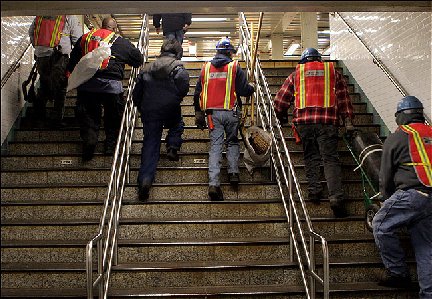
Had a great weekend in New York, and got to see several friends (including this one) in various parts of the city, thanks in no small part to the hard work of the MTA employees who make the subway run every day. My sense is that Steven Greenhouse is largely right in his assessment that the deal represents a real victory for the Transport Workers’ Union. The biggest concession made by the union, its agreement to have workers pay a small portion of healthcare costss, is a real and unfortunate one. But it managed to hold the line on pensions and dramatically retroactively improve the the pensions of many workers while winning maternity leave and an MLK Day holiday. And the union routed the MTA on the issue likely to have the greatest long-term significance: the MTA’s bid to create a two-tiered workforce by convincing current workers to sell out the men and women who will do their jobs in the future by consigning them to inferior contracts.
That transit workers were derided as selfish for striking to protect the benefits of future workers is one of the bitter ironies of this strike (there are others, like the absence from the press of mention that the MTA’s insistence on pension concessions was as illegal as the union’s strike). But evaluating the nobility of choices based on whether they are in the self-interest of those who take them is a bankrupt approach anyway. These workers made the difficult choice to strike their jobs and picket in the face of freezing weather and hostile media to secure better livelihoods for themselves and their current and future co-workers. And then they went back to work at a job few of the perpetually aghast conservatives heaping racialized insults on them could imagine doing.
It’s a shame it had to come to a strike. This contract could have been signed a month ago if George Pataki had wanted it. The last minute worsening of the MTA’s contract suggests that what he wanted is a strike, and he got it. In terms of public opinion, however, things didn’t quite go the way he planned.
Continuing the tradition from last year, here’s a post from each month of the past year:
January: Run Russ Run
February: Why We Sat In
March: Taking Blacks for Granted
April: Neo-Confederate Nostalgia
May: The Change to Win Agenda
June: Defending Durbin
July: The Lochner Litmus Test
August: Populism is Not Prejudice
September:Career Path to Motherhood?
October: Rosa Parks, Misremembered
November: Good Labor News
December: Democracy in Latin America
Thanks for reading. Happy New Year.
Over at TPMCafe, Mark Weisbrot responds to my critique of Corrales’ argument about Hugo Chavez with a critique of Corrales’ factual claims. That includes Corrales’ allegation that Chavez made Venezuelans’ votes a matter of public record, an allegation which I inaccurately implied was grounded in fact. Weisbrot corrects this and a slew of other claims in Corrales’ piece, and provokes a spirited discussion amongst the commenters as well. Progressives, as I said last week, should take well-documented violations of human rights seriously regardless of the politics of the regime perpetrating them. We should also foster a healthy skepticism towards the claims of critics whose main grievance has less to do with democracy than with opposition to the undemocratic mandates of neoliberal institutions.
Weisbrot’s Center for Economic and Policy Research, incidentally, is an excellent resource using economic arguments to challenge some of the assumptions of the Washington Consensus.
A few days ago, I watched Bill O’Reilly assure viewers of his TV show that Christians had won the War on Christmas (TM). “Christians have the right to defend their traditions,” he said triumphantly.
It’s easy to laugh at the excesses of the War on Christmas crusaders (Dan chronicled them well here). But it’s a campaign that’s worth paying attention to. It serves as a sobering reminder of how many of the standard-bearers of the right believe themselves to be spokesmen for a righteous majority besieged by hostile religious, sexual, and racial minorities.
Behind the rhetoric about religious freedom, the demand of the War on Christmas crusaders, as articulated by their most earnest advocates, is that both public and private employees greet people of all religions as if they were Christians. They want schools encouraging teachers to say “Merry Christmas” to their students and department stores encouraging check-out clerks to say it to customers. Having them say the “Happy Holidays” instead, which merely acknowledges the possibility of a multiplicity of religious observances, is to be seen as religious persecution of Christians.
Bill O’Reilly showed a Wal-Mart commercial in which “Merry Christmas” appeared on screen, but declared it only to be a step in the right direction from Wal-Mart because it appeared with the hated “Happy Holidays” and neither was mentioned in the voice-over. This is a few weeks after he showed a (year-old) clip of Samantha Bee on the Daily Show joking about separation of church and state and then sneered “Merry Christmas, Jon Stewart.”
So what we’re facing is self-appointed spokespeople for a majority insisting that everyone, be they members of the majority or not, speak as if that majority encompassed everyone in the country.
As for the real desecration of the values of Christ this holiday season, not a creature on the “religious right” is stirring, not even a mouse.
A generation ago, my Dad got kicked out of his first grade classroom for refusing to write a letter to Santa Claus. Unfortunately, that’s still what some people have in mind when they say “family values.”
Happy holidays to all our readers.
The cover story in the January/ February edition of Foreign Policy is an article by Amherst Professor Javier Corrales arguing that Venezuelan President Hugo Chavez is perfecting the art of dictatorship for the 21st century. He offers a list of Chavez’s crimes against democracy which (like an ADL report on antisemitism which conflates incidents like the Iranian President’s diatribes against Jews and some professor’s criticism of the separation wall) combines clear offenses, deft but legal manipulation of the law, and economic policy Professor Corrales doesn’t like.
Some of the abuses Corrales describes are indeed direct assaults on the democratic freedoms of Venezuelan citizens, like keeping public databases on citizens’ votes and outlawing demonstrations of “disrespect” towards government officials. Observers on the left should indeed condemn such human rights abuses, when they are clearly demonstrated, as quickly when perpetrated by leaders on the left as when perpetrated by leaders on the right. Hugo Chavez’s claims to a democratic mandate are indeed weakened by his failure to uphold some principles of democracy, and Corrales is right to call attention to these. Some ostensible abuses Corrales describes amount to effective manipulation of the parliamentary system to reduce the power of minority parties and increase what can be accomplished legislatively by a bare majority (you may know this as “the nuclear option”). I’d agree that such maneuvers are often effectively undemocratic, as long as democracy is understood as a spectrum (as a theorist like Dahl would advise) rather than a dichotomy (as a theorist like Schumpeter would). Certainly, many political structures and policies – the electoral college and the Senate come to mind – reduce the control of individual citizens over the political process. Corrales’ argument that using a majority in parliament to increase his majority on the Supreme Court itself makes Chavez a dictator makes one wonder how he views some other national leaders. Given that Corrales’ qualifications for dictatorship include intentionally polarizing the electorate so that more moderates will break to your side, it’s hard to imagine who doesn’t qualify.
Some of those leaders are distinguished from Chavez when it comes to economic policy, the area into which a third set of Corrales’ critiques of democracy in Venezuela fall. Corrales makes some of the same seemingly contradictory charges levelled against Chavez’s economic policy by a series of neoliberals and conservatives: the problem with Hugo Chavez is that he bribes the poor to like him with economic resources and that he doesn’t really provide them with economic resources and that he doesn’t really make the poor like him. Corrales’ claims of bribery of the poor in Venezuela are echoed by Ann Coulter’s complaints that Americans who benefit from government programs are allowed to vote for the perpetuation of those programs. Corrales’ grievance that Chavez distributes economic benefits as a means of reward and punishment is an important one. His attacks on Chavez for spending large sums of money to help the poor at all are less persuasive though. And his description of Chavez’s investments in alleviating poverty as a demonstration that he is a dictator will be compelling only if one believes that democratization and the right-wing economics of privatization, government-shrinking, and deregulation perversely called “economic liberalization” are one and the same. This postulate – that the “structural adjustment programs” of the IMF and the democratic reforms pursued by human rights groups are two sides of the same coin – are accepted uncritically by too many ostensibly liberal theorists in international relations and economics (not to mention the Wall Street Journal). It’s on full display in Corrales’ article, which faults Chavez as a dictator because “Rather than promoting stable property rights to boost investment and employment, he expands state employment.”
I don’t fault Corrales for seeing economics and democracy as interrelated. I’d say progressive economics that provide more people with economic resources and opportunities also empower them to exercise real voice over the choices which determine the conditions of their lives. Unfortunately, the economic regime Corrales and company favor too often has the opposite effect, plunging more people into conditions of abject poverty in which ever-greater portions of their lives slip from their control. When structural adjustment programs drive down wages, dirty water, and turn a blind eye to violent economic coercion, they erode democracy. And, as David Held argues, the means by which these programs are enacted are corrosive to a robust conception of democracy as well: they remove critical decisions about countries’ economic futures from the province of democratic oversight by citizens to the authority of distant technocrats. So it shouldn’t be surprising that the past decade has seen one Latin American country after another throw neoliberal and conservative leaders out and replace them with populists who run on opposition to the undemocratic “Washington Consensus (including Bolivia this weekend; Mexico looks likely to be next).” It’s unfortunate that some of those populists have democratic deficiencies of their own.
So I’d say Corrales gets the correlation between democracy and neoliberalism backwards, and that his opposition to Chavez’s economics drives him to put some shaky examples along with the solid ones on his list of grievances about democracy in Venezuela. Unfortunately, too many on both the left and the right go beyond arguing that economic policies increase or decrease democracy to instead reducing democracy to the favorability of a country’s economic policy. Too many let bona fide dictators like Pinochet or Castro off easy because of the economic policies they implement. People who live under such leaders deserve better.

Big week on the not-trampling-over-all-of-our-values-and-freedoms-in-the-same-of-security front. I’m skeptical of how much difference the McCain ammendment committing us not to torture will make on the ground, but it’s a good sign that even after sending Dick Cheney out of his undisclosed location and onto Capitol Hill, Bush wasn’t able to keep Congressional Republicans on the reservation (the anti-anti-torture reservation, that is). The ultimate result, in which Bush met McCain much further than halfway from his original “waterboarding is freedom” position, shows him to be a weakened President and puts this nation back on record against willfully inflicting abusive pain on prisoners. The urgency of the issue, and the limitations of legal language like McCain’s in addressing it, are reinforced in Human Rights Watch’s announcement today on pervasive torture in secret US-operated foreign prisons:
Eight detainees now held at Guantánamo described to their attorneys how they were held at a facility near Kabul at various times between 2002 and 2004. The detainees, who called the facility the “dark prison” or “prison of darkness,” said they were chained to walls, deprived of food and drinking water, and kept in total darkness with loud rap, heavy metal music, or other sounds blared for weeks at a time. The detainees offer consistent accounts about the facility, saying that U.S. and Afghan guards were not in uniform and that U.S. interrogators did not wear military attire, which suggests that the prison may have been operated by personnel from the Central Intelligence Agency…Some detainees said they were shackled in a manner that made it impossible to lie down or sleep, with restraints that caused their hands and wrists to swell up or bruise. The detainees said they were deprived of food for days at a time, and given only filthy water to drink. The detainees also said that they were held incommunicado and never visited by representatives of the International Committee of the Red Cross or other independent officials.
This “dark prison” report follows Friday’s New York Times revelation that President Bush has been authorizing the NSA to spy on Americans without even going through the secret courts designed for the purpose, which should shake any confidence one might have that better laws will fully set this administration straight. Bush apparently believes that he is authorized to personally designate Americans as surveillance targets based on the congressional resolution authorizing him to go to war in Afghanistan.
That Congress showed much less deference on Friday, when Bill Frist could only muster 52 votes for cloture on the Conference Committee’s version of the PATRIOT Act reauthorization, which took out all the civil liberties protections that Russ Feingold and others managed to get into the version passed unanimously by the Senate. In a striking victory for sensible privacy protections over fear-mongering, Feingold, Leahy, and company have kept the Senate from approving the Conference Committee Draft. It’s also a huge victory for Feingold personally, who has gone from being the only Senator to vote against the PATRIOT Act to leading a charge to continue debate on the bill which saw more Republicans cross over to oppose cloture than Democrats crossing over to support it. Looks like the Democratic leadership, rather than marginalizing him, is now trying to pull him into the party establishment, handing him a seat on the Intelligence Commission.
Hillary Clinton, meanwhile, made the news for her own sorry contribution to the discourse on patriotism and freedom: a proposal to ban flag-burning. Hers is ostensibly a compromise position in that it’s a bill rather than a constitutional amendment, and it only applies on public property or when someone is intimidated. But legitimating speech restrictions based on how uncomfortable the speech makes other people feel makes a mockery of free speech. She should know better.

What the faceless googlers apparently wanted to read about:
More from me after I get out from under the last of these papers this weekend.
 Josh Eidelson